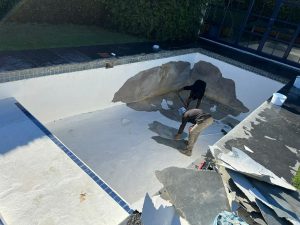
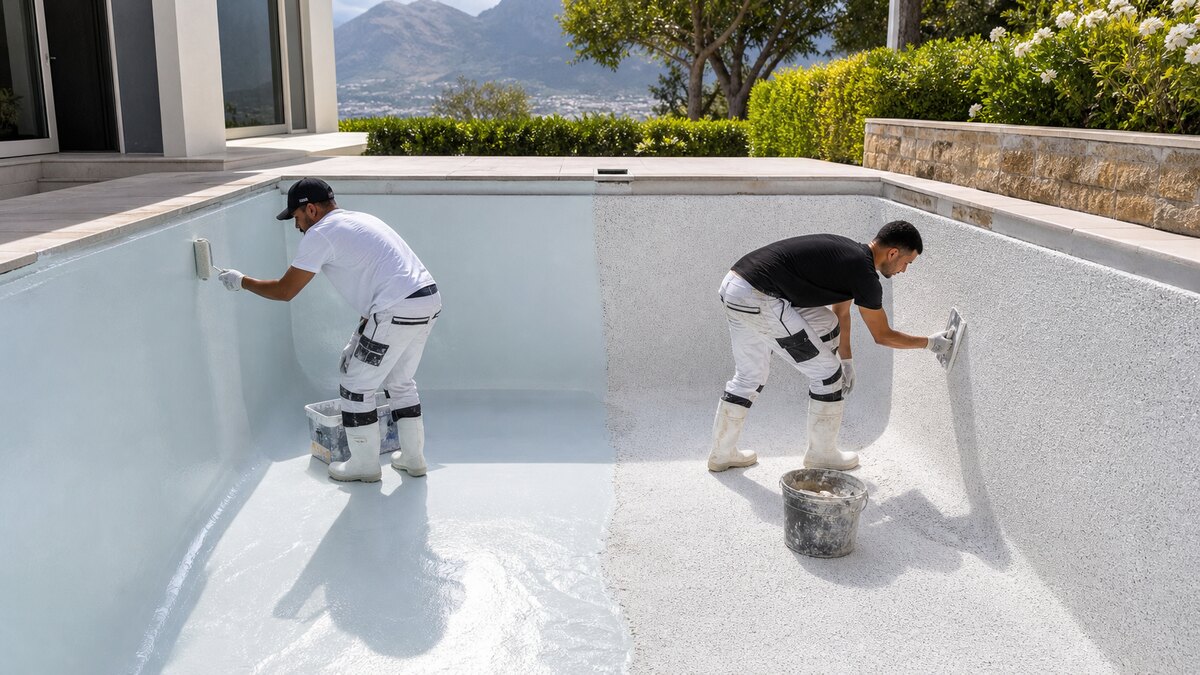
A homeowner in Bishopscourt phoned me last winter, halfway through a conversation with another contractor, asking me to settle a fight. The other guy had told her fibreglass was the only sensible option for her 38-year-old kidney-shape. She wanted a second opinion before signing anything. I drove out, looked at the pool, and told her marbelite was the right call for her specific situation. She seemed almost disappointed. People want the “best” answer. The honest answer is that fibreglass and marbelite are different tools for different jobs, and a contractor who only recommends one of them is either lazy or selling you something.
I’ve been doing pool resurfacing and relining across the Southern Suburbs and the Atlantic Seaboard for nine years. I’ve laid Marbelite over crumbling 1970s shells in Plumstead and laminated fresh gelcoat into pools that were built when Mandela was still in prison. Both materials have their place. Let me walk you through it the way I’d talk it through standing next to your pool.
What you’re actually choosing between
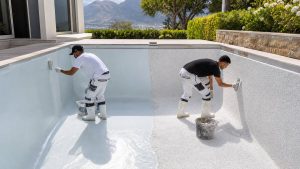
Marbelite is a cement-based plaster mixed with crushed marble aggregate. It’s the white (or coloured) interior coating most older Cape Town pools were built with. When it wears out, you chip the old layer off, do any structural repairs, and trowel a new layer on. South Africans call it Marbelite because that’s the dominant brand name here (Weber make a popular version); in the US and UK the same material is sold as marbleplaster or marblesheen.
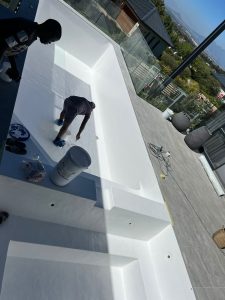
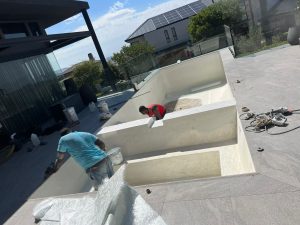
Fibreglass lining is a different animal. You’re bonding a continuous shell of glass-fibre mat and polyester resin to the inside of your existing pool, then finishing it with a pigmented gelcoat (sometimes called poolcoat). It’s not a surface treatment. It’s a watertight membrane. Done properly it should outlast the next two marbelite jobs combined.
That last sentence is where contractors stop being honest, so let me keep going.
The price gap, in real rand
For a standard 8 x 4 m Cape Town pool with a flat floor and no major structural issues, here’s roughly what I quote in 2026:
- Marbelite resurfacing: R28,000 to R45,000 depending on colour, mosaic work, and how badly the old surface needs chipping. Square-metre rates sit around R650 to R900/m² of internal surface area, all-in.
- Fibreglass lining: R55,000 to R85,000 for the same pool. Bigger jobs (12 m lap pools, freeform shapes with steps and benches) push past R110,000 quickly.
So fibreglass is roughly 1.8 to 2.2 times the cost of marbelite for the same pool. That’s the number you should have in your head when somebody tells you fibreglass “pays for itself.” Sometimes it does. Often it does. But not always, and the maths matters.
Lifespan, and why the brackets are so wide
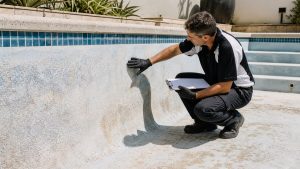
A marbelite job in Cape Town typically lasts 5 to 8 years before it starts looking tired and feeling rough underfoot. With aggressive chemistry or an owner who lets the pH wander, I’ve seen marbelite go chalky in three. With a careful owner, balanced water, and a competent original trowel job, I’ve seen ten.
Fibreglass should give you 15 to 25 years. The bottom of that range is what you get when the lamination was rushed, the gelcoat is too thin, or the pool sits in full Cape Town sun all day with no cover. The top of the range is what we see in Constantia and Newlands where there’s afternoon tree shade and the owner runs a proper cover.
So the cost-per-year comparison shakes out something like:
- Marbelite at R36,000 over 7 years = R5,140/year
- Fibreglass at R70,000 over 20 years = R3,500/year
Fibreglass wins on a long horizon. The catch is the long horizon. If you’re 71 and planning to sell the property in five years, you do not need to spend an extra R35,000 today so the next owner can enjoy year 13 of a fibreglass shell.
Feel underfoot, and why it matters more than you think
This is the thing nobody talks about until they’re standing in the water. Marbelite, when fresh, feels chalky-smooth. Within a year or two, especially with hard Cape Town tap water and any chemistry drift, it starts feeling grippy and slightly abrasive. People with thin skin on their feet notice it. Kids with new swim costumes notice it (the lycra goes off the costume faster).
Fibreglass feels like the inside of a yacht hull. Smooth, slick, almost glassy. Some people love that. A few don’t — I’ve had a client in Camps Bay specifically ask me to put a slip-resistant gelcoat on the steps because her elderly mother kept losing footing.
Underfoot grip matters most on the steps and the beach entry. If you have either, raise it with whoever’s quoting you.
Chemical efficiency and your weekly chlorine bill
A marbelite pool is alkaline. The plaster is cement-based, so it constantly leaches calcium hydroxide into the water and pushes your pH up. You’ll fight it with acid, week in and week out. New marbelite is the worst — for the first six months, expect to dose acid almost every visit.
Fibreglass is inert. The gelcoat doesn’t react with your water. You’ll use less acid, less chlorine (because algae struggles to grip the smooth surface), and you’ll spend less time scrubbing the waterline. Over the lifespan of the lining, the chemistry savings are real — call it R3,000 to R5,000 a year for an average suburban pool, more if you were running a salt chlorinator and abusing it.
Cape Town climate, specifically
This is where the local knowledge actually matters.
If you’re on the Atlantic Seaboard (Sea Point, Camps Bay, Bantry Bay, Llandudno, Hout Bay close to the beach), you’ve got salt air corrosion to worry about. That’s not really a lining problem — it eats your coping, your handrails, your pump housings, your light fittings. Both marbelite and fibreglass cope fine with the water salt levels themselves. But the salt-laden air does dull a fibreglass gelcoat faster than it would in an inland pool. Budget for an extra wax/polish every two or three years if you’re 800 m from the sea.
If you’re in the Southern Suburbs (Constantia, Bishopscourt, Newlands, Wynberg), your enemy is winter rain and leaf drop. Tannins from oak leaves and pine needles stain marbelite badly and stain fibreglass mildly. Both will recover with treatment, but fibreglass forgives you more.
If you’re inland (Durbanville, Brackenfell, Stellenbosch, parts of Somerset West), the brutal summer UV is your problem. We’re in one of the highest UV-index zones in the country. Gelcoat fades. Marbelite chalks. A pool cover during the 11am-3pm window in January and February is worth more to either surface than any other single thing you can do.
We regularly head out to Brackenfell for exactly these UV-driven resurfacing jobs, where an uncovered surface takes a beating through summer. The same story plays out further east in Somerset West, so we time those jobs around the harshest months.
And then there’s the water history. Anyone who lived through Level 6 restrictions and Day Zero in 2018 (when the city was on 50 litres per person per day and topping up a pool from the mains was illegal) knows what it’s like to watch the level drop below the skimmer. We’re on Permanent Water Bylaw rules now, which means no automatic float top-up off the mains and a cover is required. Both surfaces survived the drought fine in pools that were kept full from a borehole or wellpoint. The ones that got drained and left empty for months — that was the killer. Marbelite cracks when it dries out. Fibreglass can pop off the shell entirely if the water table comes up under an empty pool. Don’t leave a pool empty in Cape Town. Either surface, ever.
When marbelite is genuinely the right call
I’ll recommend marbelite, without hesitation, in these situations:
- The pool shell has known structural movement and you expect to do another repair within the decade. No point laminating fibreglass over a shell that’s going to crack and tear the lining with it.
- You’re prepping the property for sale within 3-5 years and want the pool to look fresh without sinking R80,000 into it.
- The pool is a heritage shape — proper rounded steps, original mosaic waterline, art deco coping — and you want to preserve the look. Fibreglass smooths everything out and you lose the character.
- Budget is genuinely the deciding factor. A fresh marbelite job at R32,000 is dramatically better than postponing the work for two more summers because you can’t stretch to R70,000.
When fibreglass is the right call
I’ll push for fibreglass when:
- The pool is leaking, not at the plumbing, but somewhere through the shell. A continuous laminate seals everything. Marbelite over hairline cracks just hides the leak for a season.
- The owner is in the house for the long haul (10+ years) and wants to stop thinking about resurfacing.
- The pool gets heavy use — holiday rental in Camps Bay, family with four kids in Constantia, anything where the water chemistry takes a beating.
- The existing surface is on its third or fourth marbelite cycle and the shell is getting too thin. Each resurfacing chips off a few millimetres. After three or four cycles you’re better off encapsulating what’s left with a fibreglass pool lining than chipping again.
Things contractors don’t tell you
A few uncomfortable truths I’d rather you hear from me than learn the hard way.
Fibreglass is only as good as the lamination. A bad fibreglass job — too few layers of mat, resin that wasn’t catalysed properly for the day’s temperature, gelcoat sprayed too thin — will fail in five years. I’ve torn off “10-year” fibreglass jobs after seven seasons because they were done by someone who’d watched a YouTube video. Ask to see references on jobs that are at least eight years old. If the contractor can’t show you any, they haven’t been doing it long enough to know whether their own work lasts.
Marbelite colour goes weird. The white version stays white-ish for years. The grey, charcoal, and “Bali blue” versions look stunning for 18 months and then start blotching as the marble aggregate weathers unevenly. If you want a dark pool, fibreglass with a proper pigmented gelcoat holds colour far better. I’ve had clients re-marbelite a pool in dark grey, hate it within two years, and pay to redo the whole thing. Don’t be that person.
“Acid wash and repaint” is not resurfacing. It’s a R9,000–R15,000 cosmetic refresh that buys you 18 to 24 months. Some contractors quote it as if it’s a proper resurface. It isn’t. It’s lipstick. Useful for selling the house. Useless if you want another decade out of the pool.
The cheapest quote is almost always the one that costs you most. A fibreglass quote that’s 30% under everyone else is either using less glass mat, thinner gelcoat, or a junior team. The materials are not where you save money on this job.
What I’d actually do at your house
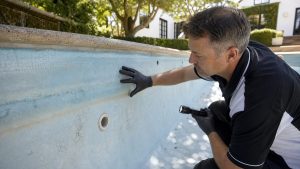
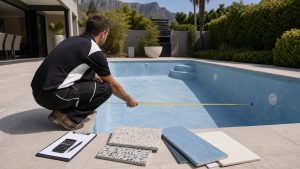
If you ask me to walk your property, I’ll look at the shell, the water chemistry history, the surrounding trees, how much sun the pool gets, your usage pattern, and how long you’re planning to stay in the house. Then I’ll give you one recommendation, not three options designed to nudge you toward the most expensive one. Sometimes that recommendation is marbelite resurfacing at R34,000. Sometimes it’s fibreglass at R72,000. Once or twice a year it’s “don’t touch it for another two summers, your surface has more life in it than the last contractor told you.”
If you’d like that kind of straight answer for your own pool, book a site visit through the quote form or call me directly on +27 62 635 8990. I’ll come out, look at it properly, and tell you what I’d do if it were my own.