The conversation usually goes like this. A homeowner phones, describes their pool roughly, and asks “what does it cost to resurface?” I give them the honest range. There’s a pause. Then they tell me they’ve already had a quote for less. Sometimes a lot less.
That quote is almost always missing something. Drain disposal. Crack repair. Cure-day insurance. The cost of refilling 35,000 litres of water at 2026 City tariffs while the pump runs around the clock to circulate it. I’m not bashing the competition. I’m telling you that pool resurfacing pricing in Cape Town has more moving parts than most trades, and a quote that looks too good usually is.
This is what it actually costs to resurface a pool in this city in 2026, broken down the way I’d want it explained to me if I were on your side of the conversation.
The two main jobs and why they cost different money
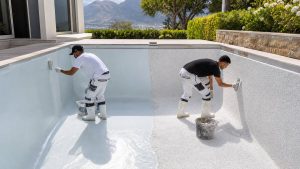
Almost every resurfacing job in Cape Town falls into one of two camps. Re-marbeliting (stripping the old marble-cement finish, re-prepping the shell, and applying fresh marbelite). Or fibreglass relining (laying a new fibreglass and gelcoat lining over the existing shell, whether that shell is gunite, marbelite, or older fibreglass).
Re-marbeliting in 2026 sits roughly at R650 to R950 per square metre of wetted surface area for the finish work itself, depending on prep complexity, colour pigment, and whether the contractor is using a standard or premium marbelite mix. Premium mixes with finer aggregate and better long-term colour retention sit at the top of that range.
Fibreglass relining runs R850 to R1,400 per square metre of wetted surface area, depending on the resin spec (vinyl-ester resists osmosis far better than standard polyester and costs more), the number of fibreglass mat layers, and the quality of the topcoat gelcoat. Most reputable Cape Town contractors are using vinyl-ester now because the failures we saw on older polyester pools in the 1990s and 2000s taught the industry an expensive lesson.
Those are per-square-metre numbers. To turn them into a real budget you need to add up your wetted surface area (floor plus all four walls below the water line), then layer in everything else that has to happen for the surface work to actually take place.
What you actually pay for, by pool size
Here’s how the maths plays out for the three sizes we see most often in Cape Town homes.
Splash pool (roughly 4m x 3m, average 1.4m depth)
Wetted area: about 32m². Water volume: around 17,000 litres.
- Re-marbelite, all-in: R28,000 to R42,000
- Fibreglass reline, all-in: R38,000 to R55,000
These are the jobs where the per-square-metre rate hides the real economics. The fixed costs of mobilising a crew, draining the pool, and refilling are the same as on a bigger job, so the rate per metre effectively goes up. Anyone quoting you R18,000 for a splash pool resurface is cutting corners somewhere, usually on the prep.
Standard family pool (8m x 4m, average 1.5m depth)
Wetted area: about 68m². Water volume: around 48,000 litres.
- Re-marbelite, all-in: R55,000 to R85,000
- Fibreglass reline, all-in: R75,000 to R110,000
This is the bread and butter of what we do across Constantia, Bishopscourt, Durbanville and Somerset West. A solid 30-year-old gunite pool, marbelite at end-of-life, gets a fresh white or pale-blue marbelite finish and looks like a new pool for fifteen years.
Large pool (10m x 5m, average 1.6m depth, or anything with a tanning ledge or a beach entry)
Wetted area: about 98m² and often more once you account for steps and ledges. Water volume: 70,000 litres or higher.
- Re-marbelite, all-in: R75,000 to R125,000
- Fibreglass reline, all-in: R100,000 to R165,000
Larger pools also tend to be older, more complex, and more likely to have a hidden surprise (failed waterproofing behind a retaining wall, a structural crack, mosaic tile work that needs lifting and resetting). Budget for variation.
Inside the quote: what’s actually in there
A proper resurfacing quote in Cape Town in 2026 should itemise these things. If yours doesn’t, ask why.
- Drain and dispose. Pumping out the existing water and discharging it legally. The City has rules about pool water entering the stormwater system, particularly if it’s chlorinated above 0.5 ppm or has copper-based algaecide in it. Budget R1,500 to R4,000 depending on volume and discharge location.
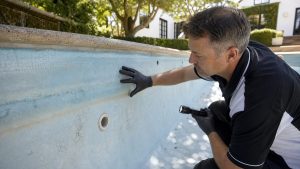
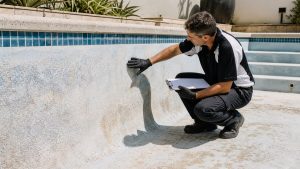
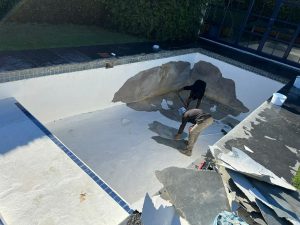
- Surface prep. The single most important line item and the one most often shortcut. For marbelite, this means chipping the surface to a rough key, cutting back under tile bands and around lights and skimmers, acid washing, and rinsing. For a fibreglass reline, prep means scuffing the old surface, repairing any blistered areas, and applying a primer that bonds with both the substrate and the new laminate. Allow R6,000 to R15,000 depending on size.
- Crack repair. Routing out any cracks, injecting epoxy or polyurethane grout, and re-screeding. Hairline crazing is included in basic prep. Structural cracks add R3,000 to R12,000 depending on length and depth, and on whether soil voiding under the slab needs addressing first.
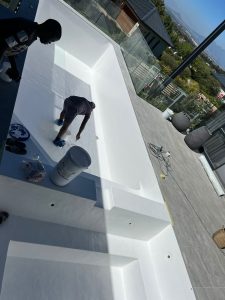
- Bond / base coat. A thin scratch coat that gives the finish coat something to grab. Needs three to five days to cure properly. Skipping this or rushing it is the number one cause of finish-coat failure within two years.
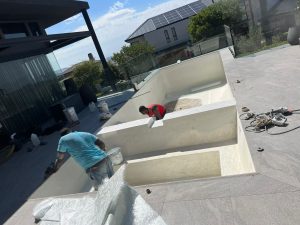
- Finish coat. The marbelite trowel application or the fibreglass laminate and gelcoat. This is the line item that’s most legitimately variable because product choice (Weber marbelite versus a budget local mix; vinyl-ester resin versus polyester) genuinely affects long-term performance.
- Refill costs. Often quoted as “client to fill.” Don’t let that slide past. We’ll get to the real number below.
- Equipment fees. Compressors, mixers, pumps, scaffolding for deeper pools. Some contractors itemise this; others fold it in. Either is fine. What’s not fine is being charged a separate “site fee” mid-job.
The costs that catch people out
This is where I get tradesmen calling me upset for being too honest, but the homeowner is the one paying so they should know. For related pool renovation planning, Aquatic Pools services can help match the repair method to the pool surface and Cape Town conditions.
Refilling the pool at 2026 tariffs
The City of Cape Town’s residential water tariffs are stepped. The first 6,000 litres a month sit at the cheapest tier. Anything beyond that climbs steeply. If your normal household uses 15,000 litres in a month, and your resurfacing job adds another 50,000 litres of pool refill on top, that refill water is being charged at the highest tier plus sanitation levies.
Realistic refill cost for a standard 8×4 pool in 2026: R1,800 to R3,200 on your next municipal bill. For a 10×5 with a tanning ledge: R2,800 to R4,500. Worth budgeting for. Worth also asking your contractor whether they have a relationship with a borehole-water supplier who can deliver at roughly half the City rate.
Pump running through the curing period
Both marbelite and fibreglass need the pump running pretty much constantly for the first 14 to 21 days after refill to circulate water and keep chemistry balanced while the surface finishes its underwater cure. That’s 24-hour pump operation on a Pentair Intelliflo, Hayward, Sta-Rite or Speck unit, roughly 600 to 1,200 watts depending on the model. Two to three weeks of round-the-clock running adds roughly R400 to R900 to your Eskom bill. Small number, but nobody mentions it.
Tiles, lights, skimmer faces
Old waterline tiles often crack during the chipping and prep work. So do light fittings and skimmer face plates that have gone brittle. A good contractor will warn you upfront that anything visibly fragile may need replacement and will quote you a contingency. Expect R3,000 to R12,000 for waterline tile replacement on a typical home pool. LED light replacements run R2,000 to R6,000 each. Mosaic feature panels (Luxor or similar) cost more again if you have them and they’re damaged.
The cure-failure clause
This one matters and almost nobody talks about it. Marbelite needs to be filled with water within roughly 24 hours of being trowelled. If the weather turns and we get a hot dry Berg wind, or if the homeowner takes too long to start the fill, the finish can develop micro-shrinkage cracks. In bad cases the entire surface has to be stripped and redone.
Read the small print on who carries this risk in your contract. The good operators carry it themselves and price accordingly. The cheap operators put it on you with language like “client responsible for fill timing.” If something goes wrong, you’re paying for the second attempt.
The Day-Zero hangover
Cape Town’s water history matters here. After the 2018 Level 6 restrictions and the 50 litres per person per day rule, the City introduced a stricter pool-refill exemption process that’s still in force in modified form. If we go back to Level 3 or higher restrictions (and dam levels in early 2026 have been the lowest since 2018), refilling a freshly resurfaced pool with municipal water can require an exemption, or worse, become outright impossible. We had clients during the drought waiting six months for water trucks. That risk is back on the table this year. Worth a conversation about timing.
Contractor pricing tactics to watch for
I want you to walk away from a resurfacing decision feeling like you got a fair deal, so here’s what I’d flag if I were sitting on your side of the table.
The verbal quote that “we’ll firm up when we drain it.” Drain it first, then commit to the price. Sometimes that’s genuine because you really can’t see structural issues until the pool is dry. But it’s also a classic way to get you committed and then escalate. Insist on a worst-case ceiling figure before they pull a single litre.
The “all included” headline number with no line items. If the quote is one figure with no breakdown, you can’t compare it to anyone else’s and you can’t argue about what’s missing. Ask for an itemised proposal. Anyone serious will give you one.
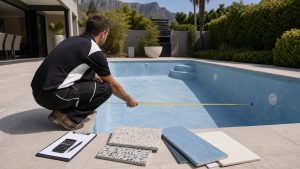
The cheap finish coat with no spec. “We’ll be applying marbelite” is not a spec. Which marbelite? What aggregate size? What pigment system? Standard Weber? An imported product? A site-mixed batch from cement and marble dust? These have radically different lifespans. Same question for fibreglass: polyester or vinyl-ester resin? Two layers of 450 gsm mat or three? Topcoat or gelcoat finish? The answers determine whether your job lasts eight years or twenty.
The deposit that’s bigger than the materials cost. Standard in our trade is 40% on signing, 40% on completion of base coat, 20% on water-fill day. Anyone asking for 70% upfront is funding their last job with your money, and that’s a risk profile you don’t want.
The “we can start Monday” miracle. Good contractors in Cape Town are booked four to eight weeks out for resurfacing in summer. If someone says they can be there next week in November, ask yourself why nobody else has booked them.
An honest range for each pool size
Let me pull the numbers together into single ranges that include everything: prep, repair, finish, refill, contingency, the lot. These are what I’d give a friend who asked me what they should plan to spend in 2026.
- Splash pool (under 35m² wetted area): R32,000 to R48,000 for re-marbelite. R42,000 to R62,000 for fibreglass reline.
- Standard 8×4 family pool (around 65–75m² wetted area): R60,000 to R95,000 for re-marbelite. R82,000 to R125,000 for fibreglass reline.
- Large 10×5 or feature pool (90m²+ wetted area): R85,000 to R140,000 for re-marbelite. R115,000 to R185,000 for fibreglass reline.
What pushes you to the bottom of that range: a structurally sound shell, easy site access, straightforward shape, you’re happy with a standard white or pale-blue colour, no waterline tile or mosaic work needed, no light replacements, no plumbing repairs piggybacking on the job.
What pushes you to the top: structural cracks needing repair, soil voiding under the slab, complex shape (kidney, freeform, infinity edge), premium imported finish materials, full waterline tile replacement, multiple light or skimmer replacements, a difficult site access (we’ve worked Camps Bay jobs where every bag of marbelite had to come down 80 steps from the road).
One more thing about timing
April to August is the right window to resurface in Cape Town. Cooler weather means the bond coat cures more predictably. Water demand on the City is lower so refill is easier. Your pool is out of action during months you weren’t using it anyway. And contractors aren’t running flat-out, which means more attention on your job and often a slightly keener price.
September to November is the panic window. People realise summer is coming and try to get jobs done in eight weeks that should have been booked four months earlier. Don’t be that homeowner. If you’re seeing the signs now, get a quote now even if the work happens in May.
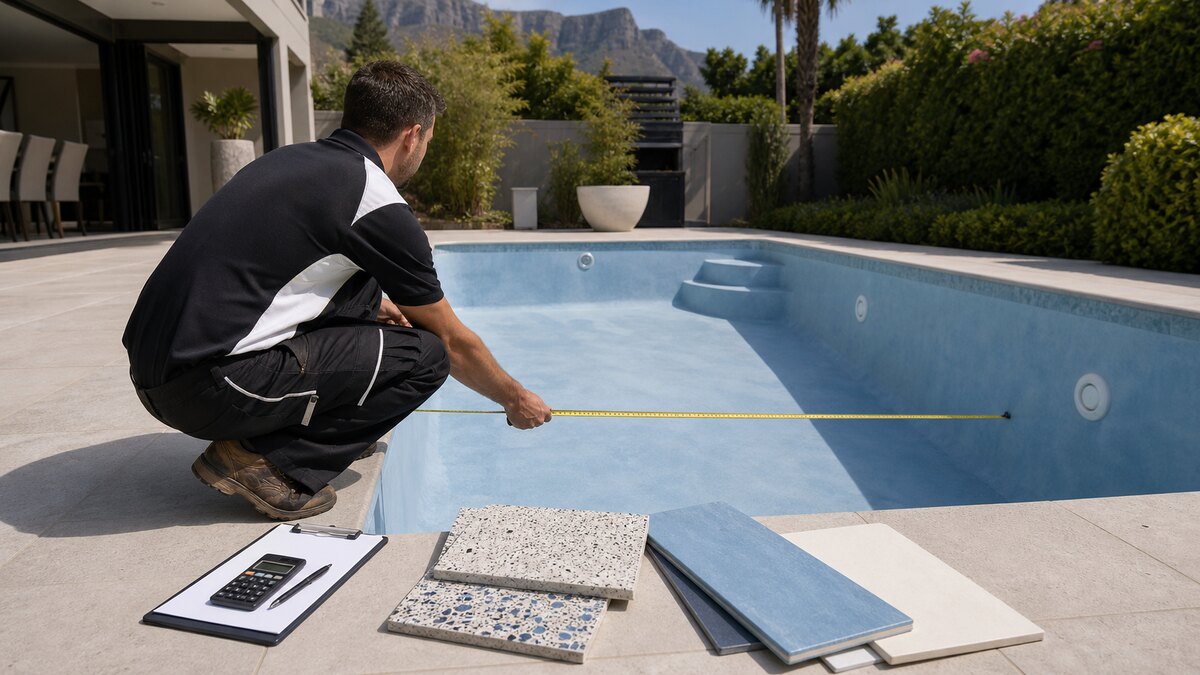
If you want a written, itemised quote with three options at three price points (we always show you a budget, a mid-range, and a premium spec so you can make a real decision), request a quote here or phone us on +27 62 635 8990. We’ll walk the site, get in the water, and give you numbers we’ll stand behind. Full detail on what’s involved is on the services page, and if you’d like, we can also send you a sample of the marbelite or gelcoat colours we work with so you can see the finish in your own light before you commit.
More background on the resurfacing process itself is worth reading before you decide.