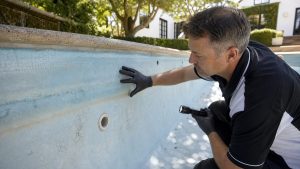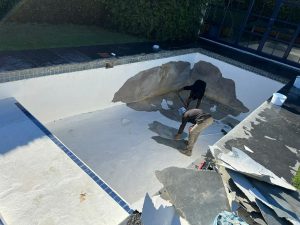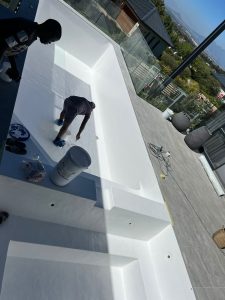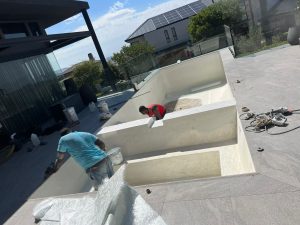
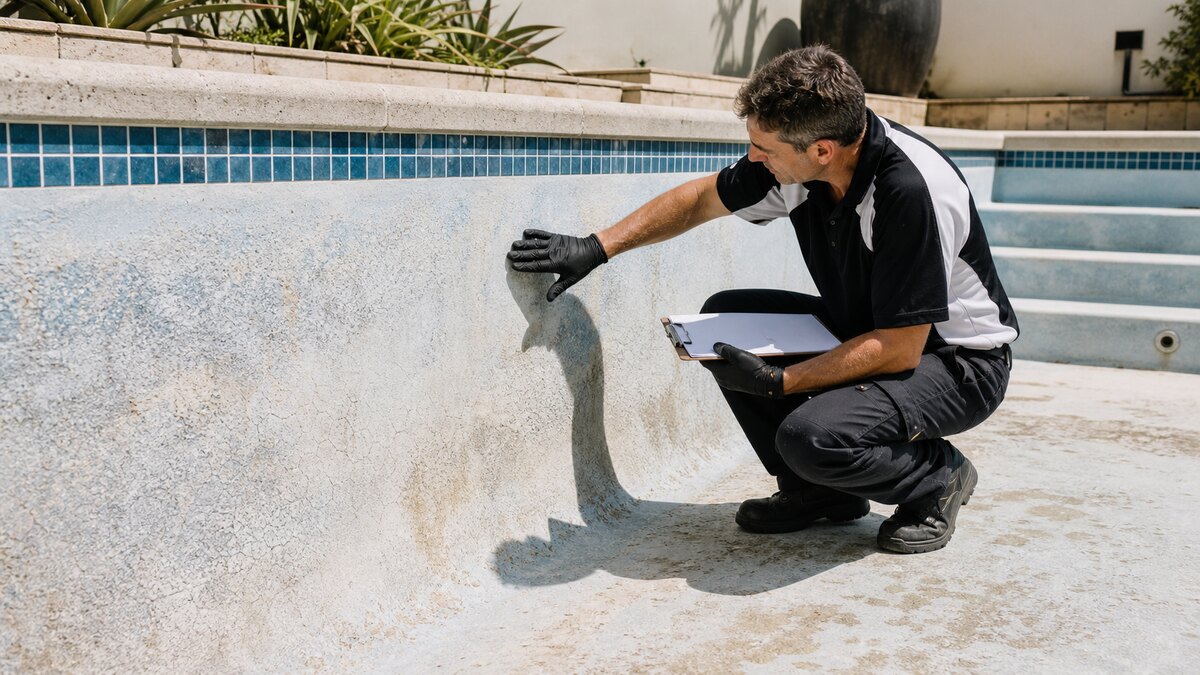
Last March I got a call from a homeowner in Bishopscourt who’d noticed a thin brown stain creeping along the shallow-end step of her 1990s marbelite. She’d been scrubbing it every Saturday for six months. Bleach, acid, a scrubbing brush that had seen better days. Nothing shifted it. By the time I drove out, the stain wasn’t the problem anymore. The problem was the surface around it. I ran my palm across the floor near the main drain and it felt like coarse 80-grit sandpaper. The marbelite had been at end-of-life for two summers. The stain was just the symptom that finally got loud enough to make her phone someone.
That’s how almost every resurfacing job starts in this town. Not with a dramatic failure. With one nagging thing the homeowner finally couldn’t ignore.
What follows are the seven signs I look for on every site visit, in roughly the order they show up. Some of them can wait six to twelve months without much drama. A couple of them can’t wait at all. I’ll be honest about which is which, because in this trade there’s a lot of fear-selling and I don’t have the stomach for it.
1. The run-your-hand test fails
Strip off your shoes. Get in the pool. Run your palm flat across the floor in the deep end, then up a wall, then across the shallow end where most foot traffic happens. A healthy marbelite surface feels like a smooth river stone. A healthy fibreglass gelcoat feels like the inside of a clean bathtub.
What you do not want to feel is grit. If your palm comes away feeling like you’ve just rubbed it on a brick, the binder in the marbelite has eroded and the harder aggregate (the marble dust and chips) is now standing proud of the surface. This is what we call exposed aggregate, and it’s the single most common reason marbelite pools come up for resurfacing in Cape Town.
Why does it happen? Two things. Aggressive water chemistry over years (low pH, high chlorine, anything below 7.2 pH for sustained periods) etches the calcium binder out. And simple age. A well-built marbelite finish in this climate has about a 12 to 18 year service life. After that, the surface is just slowly dissolving into your water.
How serious: Not urgent on its own, but it’s the warning shot. Once the aggregate is exposed, algae now has thousands of microscopic anchor points and you’ll start losing the chemical-balance war. Plan to resurface within 12 months.
2. Staining that absolutely will not come off
Every pool gets the occasional stain. Leaves left in the corner, a rusted hairpin, a bit of fertiliser blown in from a Camps Bay garden. Those come off with a scrub or a localised acid treatment. That’s normal.
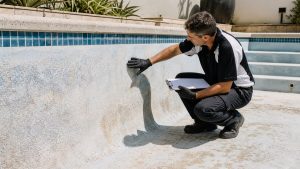
What’s not normal is staining that’s gone into the surface. The test I use: if you can’t lift the stain with a stiff brush, a vitamin C tablet held against it for sixty seconds, and a follow-up with diluted muriatic acid, the stain isn’t sitting on top of the marbelite anymore. It’s part of it. The surface has become porous enough that copper, iron, manganese, organic tannins, you name it, have soaked into the matrix.
You see this a lot in Constantia and Hout Bay where the borehole water carries a fair bit of iron. The marbelite is acting like a sponge for whatever’s in solution.
How serious: Cosmetic, mostly. But it’s a reliable second-stage indicator that the surface is at end-of-life. If your pool also fails the run-your-hand test, this confirms it. Spot-patching doesn’t work because the new patch will sit at a different shade and you’ll see the ghost of the old stain creeping back through within a season.
3. Fine hairline cracks (and how to tell them from the dangerous ones)
Here’s where I have to slow down, because there are two completely different things people call “cracks” and they have completely different consequences.
Hairline crazing
Fine spider-web cracks, usually shorter than 100mm, often radiating from a central point. They look alarming. They’re almost always cosmetic. This is the marbelite’s surface shrinking against the gunite shell over years of thermal cycling. It’s the same thing that happens to old paintwork. The shell underneath is sound. Your pool is not leaking.
Fibreglass gets these too. We call it “stress crazing” on a gelcoat. Same story. Cosmetic.
Structural cracks
A single, decisive crack. Usually longer than 300mm. Often runs in a relatively straight line, or follows a corner, or crosses from floor to wall. Sometimes you’ll feel a lip where one side has risen slightly above the other. These are the ones that worry me. They indicate movement in the shell itself, either from soil shift, a leaking pipe behind the wall washing fines out from under the slab, or in the worst cases a structural failure of the gunite.
I had a job in Plumstead last winter where the homeowner had been told for three years it was “just a hairline.” When I pulled the pool apart there was a 1.4m structural crack running diagonally across the deep-end floor and the soil under it had voided badly. We had to inject grout under the slab before we could even think about resurfacing.
How serious: Crazing can wait until the rest of the surface is also due. A structural crack needs an engineer’s eye within weeks, not months. Don’t paint over it. Don’t fill it with silicone. Get someone qualified to look at it.
4. The pool is losing more water than the weather can explain
Cape Town gets hot, dry summer winds. A pool with no cover will lose 5 to 10mm a day in February. That’s normal evaporation. You should be topping up roughly the equivalent of one bucket per square metre of surface area per week in peak summer.
If you’re losing significantly more than that, and especially if the loss continues at the same rate after a cold, still, overcast week, you have a leak. The bucket test is the standard way to confirm: float a bucket in the shallow end with water in it, mark both water levels (pool and bucket) and check after 48 hours. If the pool level dropped more than the bucket level, you’re leaking.
A surface that’s reached end-of-life can absolutely be the cause. Marbelite that’s calcium-leached enough to feel rough is also porous enough to wick water through to the gunite. Fibreglass where the lining has detached from the floor (you can sometimes hear a squelchy sound when you walk across the affected area) will allow water to pool behind the laminate.
How serious: If you’re losing more than 25mm a day and it’s not in the middle of a Berg wind, treat it as urgent. The water itself is the smaller problem. The bigger one is what that water is doing to your foundations, your retaining walls, and your neighbour’s garden. I’ve seen Constantia pools wash so much soil out from under a patio that the paving collapsed.
5. Chalking and efflorescence
Wipe a finger along the waterline tile or the marbelite just above the water level. If it comes away with a fine white powder on it, that’s chalking. The cement binder in the marbelite is breaking down at the surface and the calcium is migrating out.
Efflorescence is the related cousin. White, crusty deposits that bloom out of cracks or tile grout. It’s mineral salts being pushed to the surface by water moving through the structure from behind. You’ll see this a lot on infinity edges and on pools built into a sloped Sea Point or Fresnaye plot where there’s groundwater pressure from the high side.
How serious: Chalking on its own says the surface is in its last few years. Efflorescence says water is moving through your shell from somewhere it shouldn’t be, and that means waterproofing failure behind the marbelite. The first is plannable. The second is more urgent, because once water gets behind a surface, freezing nights and thermal expansion will lift sheets of it off within a season or two.
6. The colour has gone
White marbelite goes cream. Cream goes yellow. Blue marbelite (the Luxor-style pigmented mixes a lot of older Stellenbosch and Somerset West pools used) goes a pale, washed-out grey-green. Fibreglass gelcoat fades from a deep aqua to a flat, milky pale shade, especially on the sun-facing wall.
UV is brutal here. We’re at the southern tip of a continent with very thin atmospheric protection from solar radiation, and a pool sitting open from October to April is getting hit hard. Most pigment systems are rated for ten to fifteen years before noticeable fade, and after that the colour shift accelerates.
How serious: Pure cosmetics. Faded colour does not affect structural integrity, water chemistry, or safety. But it usually arrives alongside one or two of the other signs on this list, and at that point you’re resurfacing for function anyway. The colour just makes the decision easier to justify to the household.
One thing worth saying. If your pool has gone from blue to that flat washed-out shade, you’ll be amazed at the difference a fresh marbelite finish or a new gelcoat makes. People rediscover their gardens. We had a client in Durbanville last year who told us she hadn’t actually used the pool in three summers because it looked “dirty even when it was clean.” Fresh white marbelite, three coats of pigment, and she was in it the day we filled it.
7. Gelcoat blistering on fibreglass
This one is fibreglass-specific. Walk the pool dry. Look for raised bumps on the surface, ranging from pinhead size to as big as a R5 coin. Press them with a thumbnail. If they’re soft, or if they crack and weep a dark brown or amber fluid, you’re looking at osmotic blistering.
Osmosis happens when water has slowly permeated through the gelcoat and reacted with the polyester resin underneath. The reaction produces a slightly acidic liquid that pushes the gelcoat outward into a blister. Modern vinyl-ester resins resist this much better, but most fibreglass pools installed in Cape Town before about 2010 were laid up with standard polyester resin, and they’re hitting the age window now.
I see osmosis most commonly on pools fifteen to twenty-five years old, and it tends to be worst on the wall that faces afternoon sun. The heat-cool cycle accelerates everything.
How serious: Few isolated blisters, you’ve got a year or two before it becomes widespread. Once you’re seeing them across multiple square metres, the gelcoat needs to come off and the pool needs a full reline. Patching individual blisters is genuinely a waste of money. The chemistry is happening across the whole laminate, not just where you can see it.
What needs urgent attention and what can wait
Quick triage list, because I’d rather you spent your money in the right order:
- Urgent (weeks, not months): Structural cracks longer than 300mm. Water loss above 25mm/day with no Berg wind. Efflorescence with visible bulging or lifting. Soft, weeping blisters across large areas of fibreglass.
- This season (within 6 months): Widespread chalking. Exposed aggregate across most of the floor. Multiple stains that won’t lift after proper treatment.
- Next 12 months is fine: Hairline crazing on its own. Faded colour on its own. A handful of small surface stains. Mild surface roughness on a pool you only use four months a year.
Spot patch, full resurface, or full reline?
Once you’ve decided to act, the next question is how much intervention you actually need.
Spot patch. Honest answer: works for one or two isolated problems on an otherwise sound surface. A small structural crack that’s been properly investigated and stabilised. A localised area of detached fibreglass after a plumbing repair. Not a long-term answer if the rest of the surface is also at end-of-life. The new patch will always be visible and it doesn’t extend the life of the surrounding material.
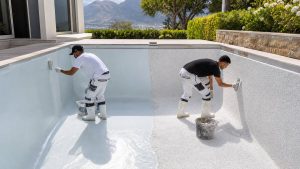
Full resurface. The right call for a pool where the shell is structurally sound but the finish is worn. Strip the old surface back, do any crack repairs, apply bond coat, apply new finish. For marbelite this is the most common job we do. The structural part of your pool was built to last forty years or more. The finish on top wears out three or four times across that life.
Full reline. Either replacing one surface type with another (overlaying tired marbelite with a fibreglass lining is increasingly common in Cape Town because it cuts ongoing chemical use), or replacing a failed fibreglass lining with a fresh one. More invasive. More expensive. Lasts longer. We talk through which makes sense on the renovations and relining page.
One last honest note
If you’ve read this list and you’re nodding along at five or six of them, the surface is gone. You already know it. The question now isn’t whether, it’s when, and the answer is “before the next summer” if you want to be swimming by November. We’re typically booking resurfacing work six to eight weeks out from when we walk the site.
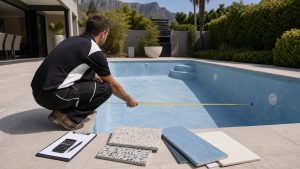
If you’d like a real look at what’s going on with your pool, we’ll come to you, get in the water, run the hand test ourselves, and give you a written quote with three options ranging from the cheapest sensible fix to the longest-lasting one. Request a quote here, or call the office on +27 62 635 8990. Even if you decide to wait a season, you’ll know exactly what you’re working with. That’s worth more than another summer of guessing. More resurfacing detail is on the services page if you want to read up first.