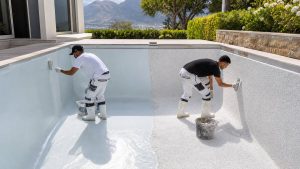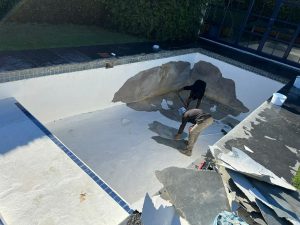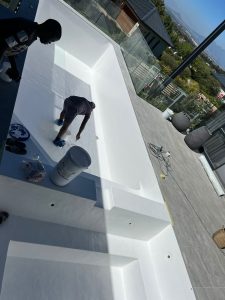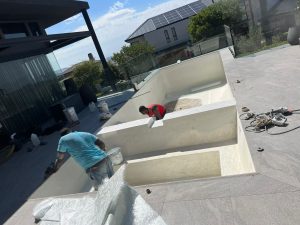
Last March I stood on the deck of a 1970s pool in Bishopscourt with the owner, both of us looking at a tired Marbelite shell that had two decades on it. She wanted to “freshen it up.” I asked her what she really wanted. After ten minutes she admitted the truth: she wanted the pool to look expensive. Not flashy. Expensive. We went with a full-interior Luxor mosaic in a sand-and-stone palette and the pool now reads, from the patio, like it belongs in a Cap Ferrat hotel. Same shell. Same shape. Different skin.
Mosaic is the single biggest visual upgrade you can give a Cape Town pool. Nothing else comes close. Not lighting, not landscaping, not even a new coping stone. So it’s worth getting right the first time, because doing it twice is painful.
What mosaic actually is, and the four materials you’ll be choosing between
“Mosaic” is a loose word in this trade. People use it to mean anything from a 20mm glass chip to a 100mm porcelain tile. For pool work in Cape Town you’re really choosing between four materials, and each has a place.
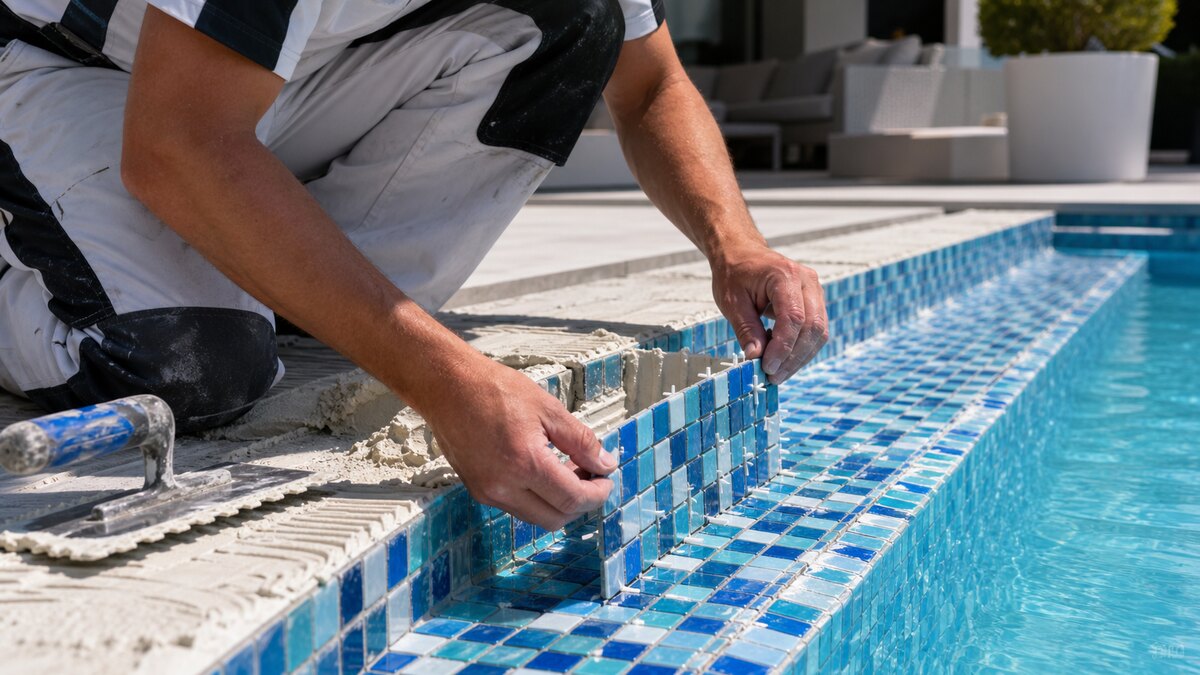
Glass mosaic. The classic. Made by fusing coloured glass into small chips (usually 20mm or 25mm), mounted on mesh or paper-faced sheets. Brilliant colour, deep saturation, holds its tone for decades because the colour is in the glass itself, not on it. Vulnerable to chipping if something heavy gets dropped on the waterline, but otherwise extremely tough. My pick for waterline borders and feature walls.
Ceramic mosaic. Cheaper than glass, available in muted earth tones, takes pattern printing well. The downside in Cape Town’s climate is the glaze. South-facing pools in Camps Bay get hammered by UV and the cheaper ceramic glazes will start to dull within five to seven years. Stick to fired ceramic from a reputable supplier.
Porcelain mosaic. Denser than ceramic, much lower water absorption (under 0.5%), better freeze-thaw performance (relevant if you’re in Stellenbosch or Franschhoek where winter mornings actually get cold). Porcelain handles pool chemistry well and the modern digital-print porcelain ranges look genuinely high-end. A bit more expensive than ceramic, a bit cheaper than glass.
Stone mosaic. Travertine, slate, pebble. Beautiful around a Constantia pool surrounded by indigenous planting. The catch is sealing. Natural stone needs a penetrating sealer redone every two to three years, and if you slack on it the stone takes up algae and you’ll never get it clean. I only recommend stone to clients who actually maintain things.
Where the mosaic goes
Most Cape Town pools don’t have full-interior mosaic. Most have it in one of four placements, and the placement changes everything about the cost and the effect.
The waterline border is the most common, and for good reason. A 150mm or 300mm band of mosaic at the waterline hides the worst of the calcium and sunscreen tide-line, gives the pool a finished edge, and only costs you a fraction of a full interior. Budget around R1,200 to R2,800 per linear metre installed depending on tile choice.
Step markers are the next-easiest upgrade. A simple inlaid mosaic strip across the front edge of each step makes the steps visible from the surface, which is a safety thing as much as an aesthetic thing. I’ve pulled too many kids out of pools where they couldn’t see the drop. Cheap to add. Worth doing.
Full-interior mosaic is the big one. The whole shell — floor, walls, steps, the lot — clad in mosaic. This is what gives you the “expensive” look. It’s also what costs you R3,500 to R6,500 per square metre installed, materials and labour, depending on the tile. For an average 8m x 4m pool with a 1.5m average depth, you’re looking at roughly 60 to 70 square metres of surface, so the budget conversation is real.
A feature wall — usually the deep-end wall facing the house — is the middle path. You get the visual hit of mosaic without committing to the whole pool. I’ve done a few feature walls in Sea Point apartments where the pool is small but visible from the lounge through sliding doors. Works beautifully.
Colour and pattern against the Cape Town sky
Here’s something I argue about with designers regularly. The default mosaic colour in this country is bright Mediterranean blue. Mid-blue glass, sometimes mixed with a little white. It looks fantastic in a magazine. In real life, under a hard Cape summer sun with the Twelve Apostles in the background, it can look a bit theme-park.
The palettes that actually work in Cape Town homes, in my experience:
- Sand and stone. Mixed beiges, soft greys, the occasional warm taupe. Reads as natural water over a sandy bottom. Works with white plaster homes, with fynbos planting, with raw timber decking. My most-requested palette in the last three years.
- Deep ocean. Dark teal, midnight blue, a thread of silver-grey. Reads as a deep, cold mountain pool. Brilliant for properties with a sea view because the pool blends into the horizon line. Camps Bay and Llandudno do this well.
- Slate and charcoal. Almost-black mosaic with subtle variation. Looks dramatic and architectural, gives the pool a mirror quality on a still morning. Pair with contemporary architecture or you’ll regret it.
- Soft turquoise. If you want classic pool blue but a notch more sophisticated than the default, a lighter turquoise with a touch of green reads as Caribbean, not as a public swimming pool.
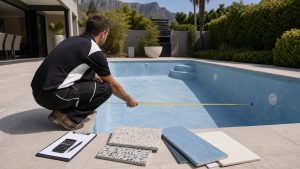
One rule. Bring a sample outdoors, in full sun, against a bucket of water, and look at it. Don’t choose mosaic under showroom fluorescents. Colour shifts dramatically when wet, and showroom lighting lies.
Mosaic on a fibreglass pool
Standard ceramic and glass mosaic sheets are designed for a cement substrate. They don’t go directly onto a fibreglass shell because fibreglass flexes and standard mortar doesn’t. So if you have a fibreglass pool and you want mosaic, you need a system specifically designed for it.
Two products dominate the South African market.
Luxor (made by Concorde Mosaics out of Cape Town) is a tissue-mounted mosaic system that bonds to fibreglass as part of the lining process. The mosaic is laid into the gel coat layer during a fibreglass relining job, becoming part of the shell itself. The aesthetic is convincing, particularly the high-definition digital range. If you’re already considering a fibreglass reline and you want a mosaic look, Luxor is the obvious answer.
Flexitile is the other widely-used tissue mosaic system, also used during fibreglass lining. Slightly different application but the principle is the same — the mosaic becomes part of the fibreglass laminate, not a layer stuck on top of it.
Both systems are around R1,100 to R2,200 per square metre on top of the standard fibreglass lining cost, depending on the design chosen. So a full fibreglass reline with Luxor mosaic on a typical pool runs in the order of R85,000 to R140,000 all-in. We do a lot of these. They hold up well, and unlike true mortar-set mosaic on a Marbelite shell, you don’t get the “tile pop” problem because there’s nothing to pop.
Mortar-bed vs bonded sheet, and why the install matters
For a traditional Marbelite or gunite pool, mosaic is installed one of two ways.
Traditional mortar bed. The installer buttering a cementitious adhesive onto the shell, pressing each sheet into it, then grouting with epoxy grout (never cement grout in a pool — it’ll fail). This is the proper way, gives the longest life, and is what we use on any full-interior or feature-wall job. It’s also slow, skilled work and that’s reflected in the labour cost.
Bonded sheet on a primed surface. A faster method using a different adhesive system, sometimes used for retrofit waterline bands where the original Marbelite is still sound. Cheaper. Acceptable for small areas. Don’t let anyone use this method for a full-interior job.
The grout matters as much as the tile. Cape Town pool water, especially in salt-chlorinated systems, will eat poor-quality grout in a few seasons. Two-part epoxy grout (Mapei Kerapoxy and Sopro EPG are the brands I trust) is non-negotiable. Cement-based grout in a pool is a callback waiting to happen.
Care, cleaning, and the inevitable popped tile
Mosaic is low-maintenance, not no-maintenance. Three things to actually do:
- Keep your water balance honest. Calcium hardness too low and the water will pull calcium out of your grout. Keep it between 200 and 400 ppm. pH between 7.2 and 7.6. This single discipline does more for mosaic longevity than anything else.
- Brush the waterline weekly. The grime that accumulates at the waterline becomes a calcium tide-mark if left, and removing established calcium from glass mosaic requires acid washing which you don’t want to be doing every year.
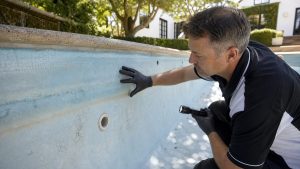
- Inspect the grout lines once a season. If you see a grout line darkening, recessing, or developing a soft spot, get it looked at before the adjacent tile lets go.
A tile will eventually pop. Even on a perfect installation. Substrate movement, an errant pool brush, a dropped umbrella stand. When it happens, fish the tile out of the pool, keep it in a Ziploc bag, and call us. A single tile reset is a quick job — usually R450 to R800 including the trip — and if you’ve still got the original tile, the colour-match is invisible. If you’ve lost it, we’ll get as close as the supplier still stocks. This is also why I always tell clients to ask for a small box of leftover tiles after the install. Store them in the garage. You’ll thank yourself in eight years.
When bespoke mosaic art is worth it, and when it’s a gimmick
About once a year someone shows me a Pinterest image of a peacock or a dolphin and asks if we can do it. Yes, we can. Honest take though.
Bespoke figurative mosaic works when the design is large, simple, and reads as graphic from above. A bold geometric pattern, a stylised sun, a clean monogram in a corner. It dates well because it’s abstract. What dates badly is detailed representational art. The realistic dolphin you loved in 2024 will look tired by 2030, and removing it means redoing that section of pool. If you want art, go abstract. Go bold. Put it on the deep-end floor or a feature wall, not the shallow end where it’s perpetually distorted by ripples.
One bespoke job I’m still proud of: a Durbanville client wanted a compass rose, three metres across, on her pool floor. We rendered it in four shades of blue-grey glass mosaic, very subtle. Six years later it still looks intentional. The trick was restraint.
What it actually costs in 2026 rands
Rough ballpark figures, Cape Town, current market:
- Waterline border, standard ceramic mosaic, supplied and installed: R900 to R1,400 per linear metre.
- Waterline border, premium glass mosaic (Bisazza-style): R1,800 to R2,800 per linear metre.
- Step markers, glass mosaic strip: R650 to R1,200 per step, depending on width.
- Feature wall, glass mosaic on existing Marbelite: R3,200 to R5,500 per square metre installed.
- Full-interior glass mosaic on Marbelite (proper mortar-bed install with epoxy grout): R3,500 to R6,500 per square metre depending on tile range.
- Fibreglass reline with Luxor or Flexitile mosaic, average 8x4m pool: R85,000 to R140,000 all-in.
- Single tile reset (warranty or out-of-warranty): R450 to R800.
Prices vary with access, the condition of the substrate, and how complicated the shape of your pool is. A simple rectangle is much cheaper to tile than a freeform with a tanning ledge and a vanishing edge.
Picking the right job for your pool
If your existing Marbelite shell is sound and you just want the pool to look more considered, do a waterline band and step markers. R20,000 to R35,000 depending on tile choice, finished in a week, transforms the look. This is the upgrade I recommend most often because the value is so disproportionate to the cost.
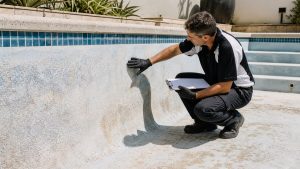
If your shell is due for resurfacing anyway, that’s the moment to think seriously about full-interior mosaic or a fibreglass-with-Luxor reline. You’re paying for the prep work either way. The marginal cost of going to mosaic is much smaller than treating it as a separate project later.
And if you have a fibreglass pool that’s lost its colour and you’re considering a reline, please don’t reline it in the same flat pigmented gel coat it had before. Spend the additional R20,000 to R40,000 and put Luxor in. The pool will look like a completely different asset and the cost difference, amortised over a 15-year lining life, is negligible.
Where to from here
Have a look at our mosaic and resurfacing services to get a feel for what we’ve been doing across the Cape. For a site visit and a fixed quote on a waterline band, feature wall, or full mosaic reline, drop your details into our quote form or phone the workshop on +27 62 635 8990. We’ll come out, look at the pool in actual daylight against your actual house, and tell you which mosaic upgrade gives you the most for your budget. Sometimes that’s the full reline. Often it’s a clever R25,000 waterline job. Either way you’ll get a straight answer.