Why a Northern-Hemisphere maintenance calendar will wreck your pool
Last October I got called out to a place in Bishopscourt where the owner had been following a pool-care schedule he’d printed off an American website. Beautiful PDF. Spring opening in March, winter close-down in October, the works. Trouble is, October in Cape Town is when your pump starts working its hardest, not when you mothball the thing. By the time I got there the cyanuric acid had crept past 90 ppm, the chlorine was doing nothing, and the water had that flat, milky look that tells you algae is twenty-four hours away.
Cape Town pools don’t close. We don’t have ice. We have a Mediterranean climate with a wet winter and a dry, windy summer, and the maintenance rhythm follows that , not some Ohio calendar. After nine years servicing pools from Camps Bay down to Somerset West, here’s how I actually run the year.
The targets you should be hitting all year
Before the month-by-month, the numbers. These don’t change much across seasons, but you adjust how often you check them:
- Free chlorine: 1.0–3.0 ppm. Lower end in winter, upper end in summer.
- pH: 7.2–7.6. Drift above 7.8 and your chlorine loses bite.
- Total alkalinity: 80–120 ppm. This is your pH buffer.
- Cyanuric acid (stabiliser): 30–50 ppm. Above 70 ppm and chlorine effectiveness drops off a cliff. This is the silent killer in Cape Town pools because summer UV is brutal and people keep adding stabilised chlorine.
- Calcium hardness: 200–400 ppm. Matters more for marbelite than fibreglass.
- Salt (if you have a chlorinator): 3,500–5,500 ppm depending on unit.
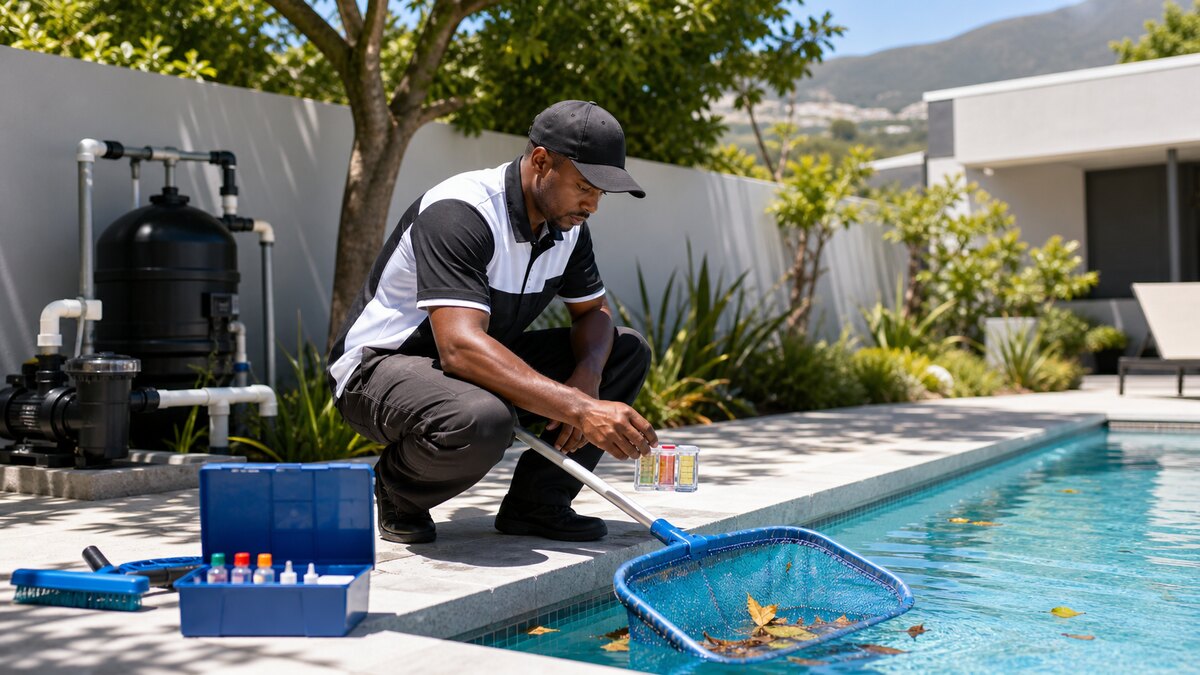
Cheap test strips lie. A proper liquid drop test kit (Pooltest, Aquadoctor, Palintest) costs around R600 and pays for itself the first time it stops you over-dosing.
November — the season starts in earnest
Water temperature climbs into the high teens, the kids start swimming after school, and the pump should already be running 8 hours a day minimum. Cyanuric acid often reads low in November because the winter rains have diluted it. Top it up to 40 ppm and you’ve bought yourself UV protection for the next few months.
Brush the waterline weekly. The first warm weather brings the first algae bloom risk, especially on the shaded south side of the pool. If you’ve got a Constantia property with big oaks dropping pollen, your skimmer basket fills daily for about three weeks. Empty it. The pump shouldn’t be working against a clogged basket.
Equipment check: open up the pump lid, look at the basket o-ring. If it’s flat and dry, replace it before summer (about R80 from Quality Filtration). A leaking pump lid sucks air, the system loses prime, and you discover this on Christmas Eve with twenty guests arriving.
December , high season, high vigilance
Bather load triples. Sunscreen, body oils, and the occasional braai-related contamination all hit the water. Chlorine demand goes up. If you were dosing 200g of granular chlorine twice a week, you might need 300g three times a week, or shift to a floating chlorinator with a couple of tablets.
Run the pump 10–12 hours a day during December and January. Anything less and you’re under-filtering for the load. A Pentair Intelliflo or Speck Badu Eco variable-speed pump makes this cheap to do; an old single-speed Quality QSpa from 2010 makes it expensive. (More on that under October.)
Test water twice a week in December. After a pool party, shock with 30g per 1000L of unstabilised chlorine (calcium hypochlorite or HTH Granular) the same evening. Don’t use stabilised “shock” products in summer — you’ll spike your cyanuric and regret it in February.
January , the south-easter chapter
This is when the Cape Doctor really shows up. If your pool is in Camps Bay, Bakoven, Llandudno or Hout Bay, the south-easter blows from late morning till sunset most days, and it drops grit, leaves, fynbos seed pods and the occasional palm frond straight into the water. Skim daily. Actually daily. Vacuum once a week minimum, twice if you’re under trees.
Pool covers help, but only the right ones. A solid winter cover in January is a recipe for algae soup underneath. A floating bubble cover works to reduce evaporation (Cape Town pools lose 8–12mm a day in peak summer) but trap heat and chlorine demand drops, so adjust accordingly.
Backwash the sand filter when the pressure gauge reads 0.3–0.5 bar above clean. Not on a schedule. Backwashing too often wastes water — and after 2018, none of us forget that. If you’ve got a cartridge filter, hose the cartridges out every 4–6 weeks. Replace them every two years.
February , watch the stabiliser
By February most pools I service have cyanuric acid creeping into the 60s or 70s if the owner has been dosing stabilised chlorine all summer. There’s no chemical that removes cyanuric. The only fix is to drain a portion of the pool and refill. With Level 1 restrictions currently allowing pool topping with municipal water, this is manageable — but check your suburb’s specific rules, because they shift.
February is also when calcium scale shows up on tile lines and salt-cell plates. If your pH has been drifting high (very common in summer because warm water off-gasses CO₂), you’ll see chalky deposits. Drop pH to 7.2 with hydrochloric acid (sold as “pool acid”, roughly R65 for 2L) and brush the line.
Equipment check: pump motor temperature. Touch the housing after it’s been running an hour. Warm is fine, untouchably hot means the bearings are going. Replacement bearings on a Speck or Sta-Rite are around R450 plus labour. Replacement of the whole motor is R3,500+. Catch it early.
March , still summer, don’t get complacent
Cape Town’s autumn is a soft landing, not a switch. March water temperatures are often warmer than December (the sea catches up). Keep pump hours at 8–10. Bather load drops off after schools go back, so chlorine demand eases.
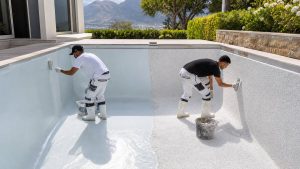
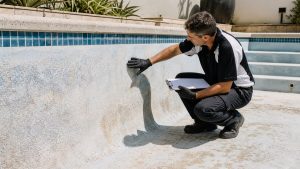
This is a good month to do a deep clean. Drain to the tile line if you need to acid-wash any plaster stains. Marbelite shells in Stellenbosch and Durbanville pick up iron staining from borehole top-ups — a sulphamic-acid spot treatment lifts it cheaply if caught early. Don’t try acid-washing a fibreglass pool yourself. You’ll etch the gelcoat.
April , the rain starts whispering
First proper cold fronts arrive in mid-to-late April. A 30mm overnight rain dilutes the top 15cm of pool water, drops your chlorine residual, and crashes pH if there’s any acid rain component. After the first heavy rain of the season, do a full water test the next morning, not three days later.
This is when leaves become a daily problem in oak-heavy suburbs (Newlands, Bishopscourt, Rondebosch, parts of Constantia). A leaf net or mesh cover saves your filter and your sanity. Cut pump hours back to 6–7 a day as the water cools and demand drops.
Service the salt chlorinator cell if you’ve got one. Vinegar soak (50/50 with water) for 15 minutes lifts the calcium off the plates. A neglected cell dies in 3 years instead of 7.
May and June — wet, cold, still your responsibility
Average rainfall hits its peak in June (around 110mm for the month). The pool fills up, the overflow runs, and chemistry gets diluted constantly. Two options here:
- Active maintenance. Keep the pump running 4–6 hours a day, hold chlorine at 1.0 ppm, test fortnightly. Pool stays swimmable on warm winter days.
- Winterising lite. Lower chlorine to 1.0 ppm, raise stabiliser slightly (35–40 ppm), drop pump hours to 3–4, cover with a proper mesh winter cover (Designer Pool Covers and Aqua-Net both make decent ones from around R3,500 for a small pool).
The mistake I see in Plumstead and Wynberg is owners who switch the pump off entirely “to save Eskom”. A pool with no circulation goes green in five days, even in 12°C water. The repair bill , drain, scrub, refill, rebalance — runs R2,500–R4,500. Run the pump.
Check your equipment and weir baskets after every big storm. Tennis balls, branches, the neighbour’s pool noodle , I’ve fished all of these out of skimmers in June.
July and August — the quiet months
Almost no one swims. Water temperature sits around 14°C. Chemistry demand is low. This is the right time to do the jobs you can’t do in summer:
- Replace filter sand. Sand has a 5–7 year life. Old sand channels water and stops filtering properly. A 25kg bag of Number 16 silica sand is around R180; you’ll need 2–3 bags for a domestic filter.
- Replace the multiport valve spider gasket if you’ve been losing water to waste during backwash.
- Service the heat pump if you’ve got one. Sea Point and Mouille Point installations corrode fast , check the evaporator fins, rinse with fresh water, replace any seized fasteners.
- Re-grout tile lines on marbelite pools where you’ve spotted hollow tiles.
One non-negotiable in winter: don’t let the water drop below the skimmer mouth. A pump running dry burns out in under a minute. After a windy week with no rain, top up.
September — wake-up time
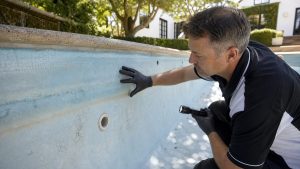
First proper warm days. Water temperatures climb into the high teens. Bring pump hours back to 6–8. Take the winter cover off, hose it down, dry it, fold it properly (folding it wet means a mouldy mess to fight with next May). Inspect the pool surface , September is when you spot the algae spots you missed in July.
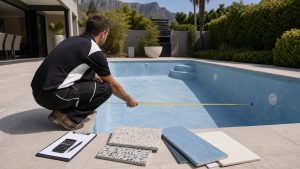
This is the right month to schedule a professional opening service if you’ve coasted through winter. We typically charge R650–R950 for a season-start service: full chemistry rebalance, equipment inspection, cell cleaning, filter check, pump prime test. Money well spent before the first 30°C weekend.
October — the pump earns its keep
UV index climbs sharply. Cyanuric acid that’s been sitting at 25 ppm all winter needs a top-up to 40 ppm. Stabilised chlorine dosing resumes carefully , overshooting in October is what creates the February stabiliser problem I mentioned above.
If you’ve been considering a variable-speed pump upgrade, October is the right month to install. A Pentair Intelliflo or Speck Badu Eco 22-91 costs R18,000–R28,000 installed and pays back in 18–30 months on Eskom savings if you were running an old 0.75kW single-speed for 8 hours a day. With load-shedding still a fact of life (even at lower stages), a variable-speed pump that can hold prime on a shorter cycle is worth real money.
Weekly vs bi-weekly service — what you’re actually paying for
A weekly service (R750–R1,200 a month in most southern suburbs, more for hard-to-access properties) is the right call if:
- You’ve got heavy tree cover (Bishopscourt, Newlands, Constantia oaks)
- The pool is used three+ times a week in summer
- You’re in a wind-exposed Atlantic Seaboard property
- You travel or simply don’t want to deal with it
A weekly service typically covers: full chemistry test and dose, skim and net, brush walls, vacuum (manual or check the auto-cleaner), empty baskets, backwash if needed, equipment visual check, top up if necessary.
A bi-weekly service (R450–R750 a month) works for compact pools, low bather load, minimal trees, and an owner who’s willing to skim and check chlorine in between. In winter, even high-end clients usually drop to bi-weekly.
What needs an actual tech, not the homeowner: salt cell inspection, pump rebuild, filter media replacement, plumbing leak diagnosis, electrical work (anything past the isolator switch), marbelite repairs, anything involving acid washing. What you can absolutely do yourself: testing, skimming, brushing, basket emptying, basic vacuuming, topping up chemicals you understand.
The honest summary, and where to go from here
Cape Town pools are easier than most people think , but the calendar is specific. You over-stabilise in summer, you under-circulate in winter, you ignore the south-easter, and you pay for it. Get the month-by-month rhythm right and a domestic pool costs R350–R600 a month in chemicals plus power, and lasts decades.
If you’d rather not think about any of it, that’s what we do. Browse our full range of pool services, or if you want a tailored quote for a weekly or bi-weekly maintenance contract on your specific pool, request a quote here or phone us on +27 62 635 8990. Tell us your suburb, your pool size, and what’s been frustrating you. We’ll come look before we quote.