The misconception I have to clear up every single week
A client in Durbanville rang me last spring, dead certain she wanted to “get off chlorine” and go salt-water. Her dermatologist had told her chlorine was aggravating her eczema, so salt-water it was. We sat at her kitchen table and I had to explain that salt-water pools are chlorine pools. The chlorine just gets made inside the pool instead of poured in from a 5kg tub. Same molecule. Same sanitising action. The salt doesn’t replace the chlorine , it’s the raw material the chlorinator uses to manufacture it.
She was a little put out. But once we worked through what a salt chlorinator actually does, she could make a real decision based on real differences, not marketing. Most of those differences are worth talking about, and a few of them genuinely matter for Cape Town homes.
What a salt chlorinator actually is
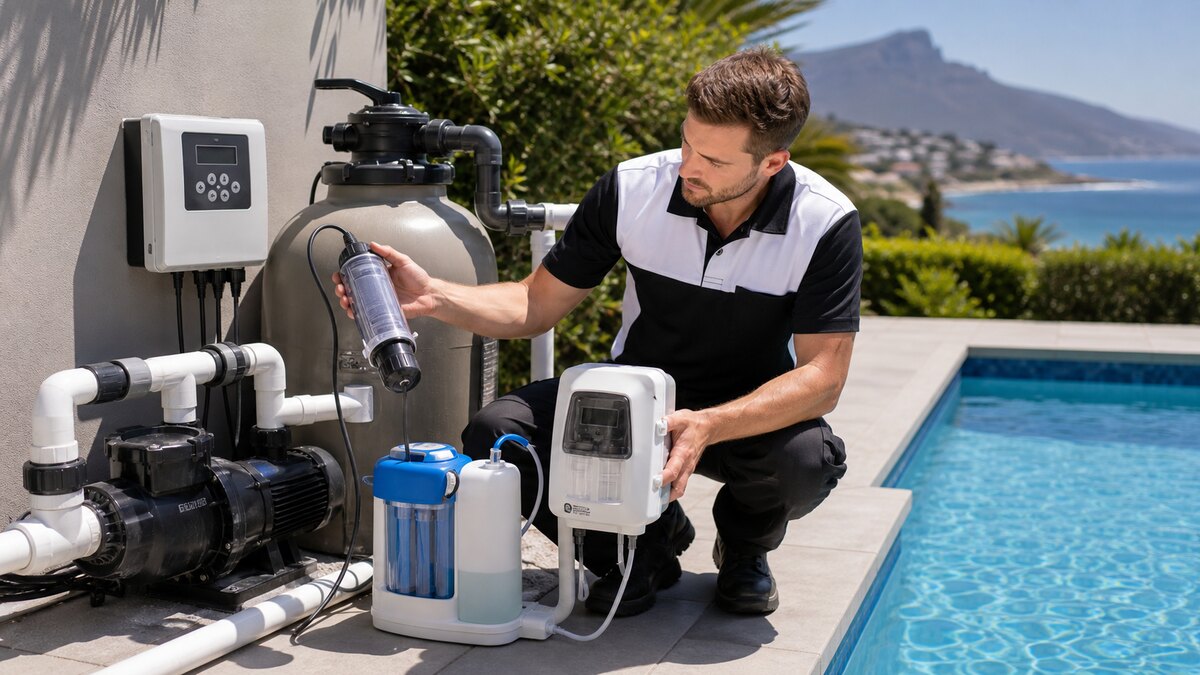
A salt chlorinator is an electrolytic cell plumbed into your pool’s return line. Water flows through it, an electrical current passes between titanium plates coated with ruthenium or iridium oxide, and dissolved salt (sodium chloride, NaCl, the same stuff you use in pasta water) gets split into sodium and chlorine. The chlorine sanitises the pool. The sodium recombines back into salt. The cycle continues every time the pump runs.
You need around 3,500–5,500 ppm of salt in the water depending on the unit’s specifications (Zodiac Ei, Quality QSpa, Pentair IntelliChlor, Hayward AquaRite, Speck and Chloromatic ESP all sit in this range). Seawater, for reference, is about 35,000 ppm. So a “salt” pool is roughly a tenth as salty as the sea — gentle on the mouth, barely noticeable on the skin.
The dosing is automatic and continuous. You set the output percentage on the controller (say, 40% in winter, 70% in summer), the cell produces chlorine on a schedule synced to the pump, and your free chlorine sits at a steady 1.5–2.5 ppm without you ever opening a bag of granules.
What it actually costs to convert in Cape Town
Real numbers from jobs I’ve quoted in the last twelve months:
- Entry-level units (locally manufactured , Quality QSpa Mini, Chloromatic ESP, basic Emaux): R6,500–R9,500 for the unit. Installation R1,200–R2,500. Initial salt charge (200kg for an average 40,000L pool at around R6/kg of pool salt): R1,200. All-in: R9,000–R13,000.
- Mid-range (Zodiac Ei, Hayward AquaRite, Speck Badu Salt): R10,000–R16,000 for the unit, R2,000–R3,500 to install, plus salt. All-in: R13,500–R20,500.
- Premium with smart controls (Pentair IntelliChlor IC40 with automation, Zodiac TRi Expert): R18,000–R28,000 unit, R3,500–R5,500 install. All-in: R23,000–R34,000.
If your existing electrical board doesn’t have a spare circuit for the chlorinator controller, add R1,500–R3,000 for a sparky. If your plumbing layout means cutting and re-running PVC to give the cell a proper horizontal mounting position, add another R800–R1,500.
The R10,000–R20,000 range I quoted at the start covers about 80% of standard domestic conversions in the Cape Town market. Anyone quoting you R5,000 is selling you an undersized unit that’ll die in three years. Anyone quoting you R40,000 for a normal residential pool is taking the mickey, unless there’s automation and remote controls bundled in.
Running costs — the part that surprises people
Three things go into salt-water running cost: electricity, salt top-ups, and cell replacement.
Electricity: The chlorinator itself draws very little , typically 150–250W when generating. It only runs when the pump runs, so there’s no extra pump time required. With Eskom rates currently sitting around R3.20/kWh in the metro (and stepping higher in higher consumption blocks), a chlorinator running 8 hours a day costs about R5–R7 a day in direct electricity. Negligible.
The pump is the real electrical story. Whether you run salt or traditional chlorine, the pump dominates your bill. An old single-speed 0.75kW pump running 8 hours a day costs around R600/month at current rates. A variable-speed pump (Pentair Intelliflo, Speck Badu Eco) doing the same filtration job costs R150–R250/month. If you’re converting to salt-water and still running a 2010-era single-speed pump, you’re solving the wrong problem first. Sort the pump.
Salt top-ups: Salt doesn’t get used up — it gets diluted by rain, splash-out, and backwash. In Cape Town, with our 500–800mm of annual rainfall almost all falling in winter, you’ll typically add 50–100kg of salt per year. At R6/kg that’s R300–R600 annually.
Cell replacement: This is the line item buyers forget. A salt cell has a finite life , typically 7,000–12,000 hours of generation, which works out to 5–8 years in normal residential use. Replacement cells run R4,500–R12,000 depending on brand. Amortise that over 6 years and you’re looking at R750–R2,000 a year set aside for eventual cell replacement.
Total annual running cost for a salt pool: roughly R1,500–R3,500 in salt and cell amortisation, versus R3,500–R6,000 a year in chemicals for a traditionally chlorinated pool of the same size. The gap is real but not enormous.
The feel and smell — yes, it’s actually different
This is where salt-water earns its reputation. Water at 3,500 ppm has a subtle softness to it , it feels silkier on skin, doesn’t tighten swimwear, doesn’t leave that papery feel on your forearms after an hour in the pool. People with sensitive skin and eyes genuinely do better with salt-generated chlorine.
The “chlorine smell” we all associate with public pools isn’t chlorine — it’s chloramines, the by-product of chlorine reacting with sweat, sunscreen, urine and organic matter. Salt-water pools produce chloramines too, but at a lower steady rate and with less spiking, so the smell is reduced. Whether you can taste the salt depends on the person; my honest take is that most adults can detect it if they’re looking for it, kids never notice.
One real downside: salt-water can sting if it gets into a fresh cut or a recently shaved area. Traditional chlorine doesn’t do this as sharply.
What salt does to your equipment, and where it really matters
Salt is corrosive. There’s no way around this. At 3,500–5,500 ppm it’s nowhere near sea-water corrosive, but it’s significantly more corrosive than tap water, and the effect over 10–15 years adds up.
What gets damaged:
- Untreated metal fittings. Brass and chrome fixtures fade, pit and eventually fail. Stainless steel rated 304 corrodes; only 316 marine-grade stainless lasts properly in salt-water.
- Pool lights with metal trim rings. If you’ve got an older Crompton or Hayward halogen with a chromed faceplate, expect it to pit within five years. LED replacements with 316 stainless or composite trim are the upgrade.
- Heat exchangers in gas heaters. A standard cupro-nickel exchanger lasts maybe 5 years on salt-water. Titanium exchangers are mandatory if you’re combining a salt pool with gas heating. They cost R4,000–R8,000 more upfront but they’re the only thing that lasts.
- Heat pump evaporator coils if untreated. Decent brands (Madimack, Aquark, ThermoPlus) now sell coastal-spec models with coated coils for salt-water installations.
- Surrounding stonework and coping. Limestone, travertine and certain sandstones develop white efflorescence and pit over time from salt splash-out. Granite, porcelain tile, and quality concrete coping handle it fine.
- Galvanised pool-side fencing and gates. Replace with aluminium or marine-grade stainless if you’re converting.
What’s fine: fibreglass shells, properly cured marbelite (with the caveat below), PVC plumbing, modern variable-speed pumps with composite housings, cartridge and sand filters.
Marbelite vs fibreglass , does it matter for salt?
Fibreglass shells handle salt-water without complaint. The gelcoat is non-reactive and the shell has no joints for salt to wick into. This is the ideal salt-water surface and it’s why a lot of newer Cape Town builds are fibreglass.
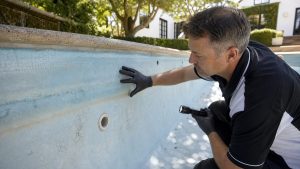
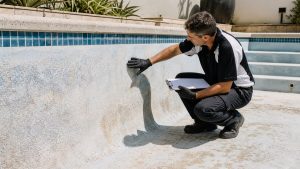
Marbelite (the white-cement-and-marble-aggregate plaster that finishes most pre-2010 Cape Town pools) is more complicated. Healthy, well-applied marbelite at the correct pH handles salt fine. But marbelite that’s already showing surface erosion, or has been allowed to drift below pH 7.0, or has been over-acid-washed in the past, will deteriorate faster on salt-water than on traditional chlorine. The salt slightly accelerates the loss of calcium from the cement matrix.
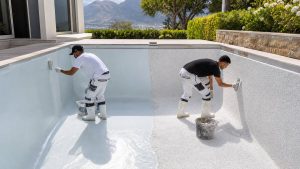
If your marbelite is past 15 years old and showing chalking, I’d resurface before converting, not after. Marbelite resurfacing in Cape Town runs R450–R750 per square metre depending on prep. Most domestic pools come in at R18,000–R40,000 for a full re-plaster. Converting to salt on a tired surface is throwing good money after bad.
The coastal-air question
Salt air at Sea Point, Camps Bay, Bloubergstrand, Llandudno is already eating your gate hinges, your roof flashings and your aircon condensers. Adding a salt-water pool 6 metres from the house — does that make things worse?
Honest answer: marginally, in the immediate splash zone. Your pool coping and the metalwork within 2 metres of the water will see more salt exposure than they would with a chlorine pool. Past that, the difference between ambient sea-air corrosion and pool-splash corrosion is small. If you’re already at the coast you’ve already specified marine-grade fittings throughout the house, presumably , your pool selection won’t change the broader picture much.
What I would change at the coast: spec the chlorinator controller with a corrosion-resistant enclosure (IP65 minimum) and mount it sheltered, not in direct sea-spray. Cheap controllers die in 3 years at coastal properties.
The variable-speed pump and chlorinator combo
The modern installation pairs a salt chlorinator with a variable-speed pump and a basic automation controller. Here’s why it works.
A variable-speed pump runs slowly for most of the day (low energy use), occasionally ramping up for cleaning cycles. The chlorinator generates chlorine whenever water flows through the cell, regardless of speed. So you get long, low-energy filtration runs that also produce steady chlorine, instead of the old model of running a hard 1.5kW pump for 6 hours and stopping. Eskom-friendly, sanitisation-stable, kinder on the equipment.
If you’re putting in a new system from scratch, this is the spec to ask for. A Pentair Intelliflo paired with an IntelliChlor IC40 and a basic automation panel is the gold standard, around R45,000–R60,000 fitted. A Speck Badu Eco 22-91 with a Zodiac Ei salt chlorinator does 90% of the job for R30,000–R42,000. Either of these will outlast the building bonds on a modern Cape Town house.
Who shouldn’t convert
Genuine straight talk. Don’t convert if:
- Your pool is under 25,000 litres. The unit cost barely justifies it on a plunge pool. Stick with tablets.
- Your marbelite is more than 15 years old and chalking. Resurface first or budget for both.
- You have a gas heater with a standard cupro-nickel exchanger and no budget to upgrade to titanium. The exchanger will fail within 4 years.
- You’re planning to sell in 18 months. You won’t recover the cost in the sale price, and prospective buyers may not value salt-water systems specifically.
- You’ve got extensive untreated metal copings, ladders, handrails or in-pool fittings that you can’t or won’t replace.
- You only swim 3 months a year and shut the pool down for winter. The cell life is wasted on intermittent use.
Convert if you swim often, the pool’s between 30,000–80,000 litres, the surface is healthy fibreglass or recent marbelite, your equipment is modern, and you (or someone in the house) has skin or eye sensitivity to traditionally dosed chlorine.
Realistic payback
I’ll be straight with you: nobody converts to salt-water for the money. The chemical savings (around R2,500–R3,500/year for a typical pool) take 4–7 years to pay back the conversion cost, and then the cell needs replacing somewhere in year 6–8 and resets the maths. People who say “salt-water pays for itself in 2 years” are selling salt chlorinators.
You convert for the water quality, the skin feel, the convenience of not handling bags of granules, and the steadier sanitisation. Those are good reasons. The money argument is honest at break-even — neither system is meaningfully cheaper over a 15-year horizon when you include cell replacements.
What to do next
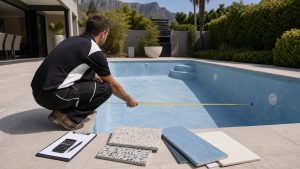
If you’re seriously thinking about it, get someone out to look at your specific pool before you order a unit. Cell sizing matters (an undersized chlorinator runs at 100% all summer and dies young; an oversized one is wasted money). Existing equipment compatibility matters. Surface condition matters. Cape Town suburbs vary enormously , what works for a fibreglass plunge in Plumstead is different from a 70,000L marbelite shell in Constantia.
We do conversions, sizing assessments and equipment audits across the southern suburbs, the Atlantic Seaboard, the northern suburbs and out to Stellenbosch. Have a look at our pool services for what’s involved, then request a quote with your pool size and current equipment, or phone +27 62 635 8990 and we’ll talk through what makes sense for your house specifically. No pressure, and if salt-water isn’t the right call for you, we’ll tell you that too.