A client in Camps Bay phoned me in February genuinely upset. She’d just spent R47,000 on what the salesman called a “premium solar safety cover,” and her pool was still losing two centimetres of water a day in the south-easter. The cover did look smart. It was also doing roughly one-third of the three jobs she thought she’d bought. That conversation is the reason I’m writing this article, because the cover market in Cape Town is the most confused category I deal with, and homeowners get fleeced in it constantly.
There are three distinct kinds of pool cover. They solve three different problems. Most marketing material smudges the lines between them on purpose. Let me untangle it.
The three categories, plainly
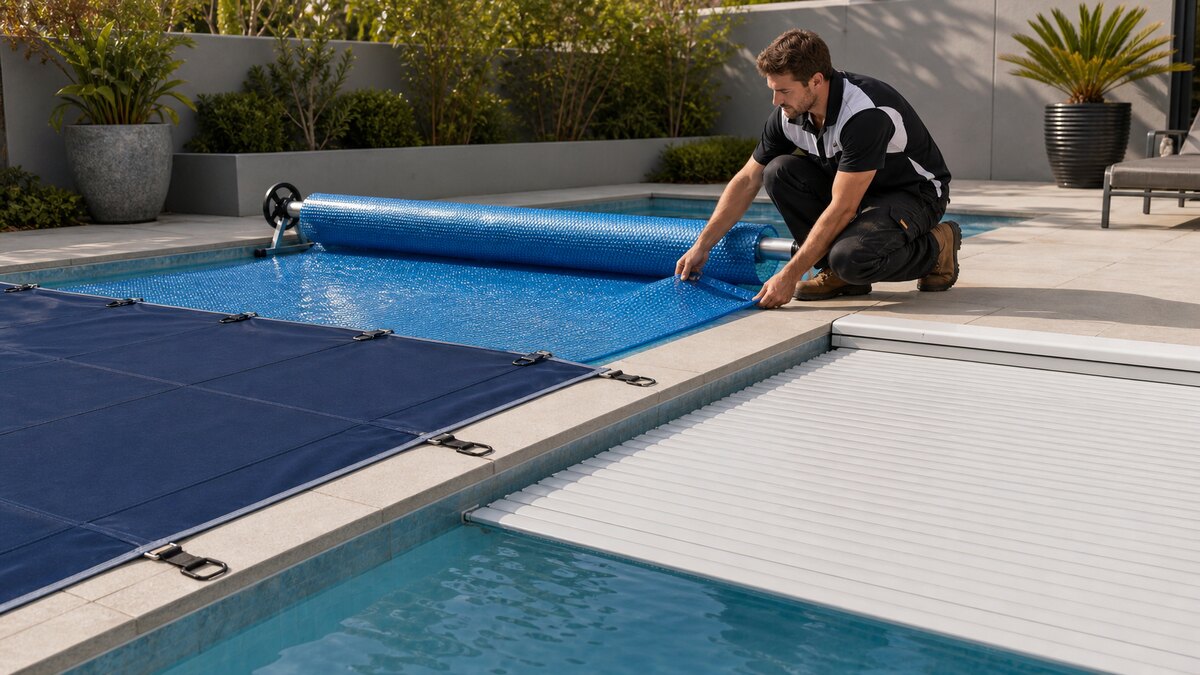
Safety covers stop a child or a dog from drowning. That’s the entire job. They’re thick PVC or reinforced mesh, anchored to the deck with brass eyelets and stainless straps, rated to hold human weight. SANS 10134:2016 is the South African standard, and any cover sold as a “safety” cover should reference it.
Thermal blankets (sometimes sold as “solar blankets” or “bubble covers”) sit on the water surface and reduce evaporation and overnight heat loss. They’re bubble-wrap on steroids, usually 400 to 500 micron, in blue or silver. They are not safety devices. A child can drown under one in seconds because it traps them against the water.
Slatted automatic covers are the premium category. Polycarbonate slats roll out from a recessed housing or a deck-mounted box at the press of a button. They function as a safety cover (when properly engineered and anchored) and as a thermal cover (the air-filled slats insulate well). They cost what a small car costs.
Those are the three. Everything else on the market is a variant. The first decision is which job you’re actually solving for.
Safety covers: when these stop being optional
I won’t quote a safety cover to someone who doesn’t need one, because they’re a hassle to live with. You pull them on and off. They get heavy when wet. The straps stretch over time. But there are three situations where I tell clients they’re non-negotiable.
First, children under ten in the household or regularly visiting. South African drowning statistics are awful, and most fatalities happen in residential pools where the kid was “only out of sight for a minute.” A SANS 10134-compliant cover or net is the cheapest insurance policy you’ll ever buy.
Second, dogs. Particularly older dogs and small breeds. I’ve pulled three drowned Jack Russells out of pools in the Southern Suburbs over the years. Two of those owners had been meaning to get a cover sorted.
Third, insurance. Some short-term insurers in Cape Town now ask whether your pool has a compliant safety cover or fence when you renew. A few will hike your premium or exclude pool-related liability without one. Worth checking your policy schedule.
For pricing in 2026, a manual SANS 10134 safety cover for a standard 8 x 4 m pool runs roughly R6,500 to R14,000 installed, depending on whether you go solid PVC (heavier, fully opaque, no evaporation, dirties up) or mesh (lighter, lets rainwater through, lets some light through, keeps the pool slightly cleaner underneath). Aqua-Net’s solid safety cover and Designer Pool Covers’ equivalent both sit in that bracket. Pool Cover SA does a competitive mesh version.
Heavier custom shapes (kidneys, freeforms with steps and beach entries) push you to R18,000 or more because every anchor point has to be measured and the cover is cut bespoke.
Thermal blankets: the Day Zero hangover
If you owned a pool in Cape Town in 2018, you remember Level 6B. You couldn’t top up from the municipal supply. You watched your water level drop in front of your eyes during the south-easter. Thermal blankets stopped being a nice-to-have and became survival equipment. The City of Cape Town’s own number was up to 95% evaporation reduction with a thermal cover, and most of us kept ours on year-round.
Seven years on, we’re sitting at Level 1 (with Level 2 looking likely for July to November 2026, depending on dam levels). The bylaws still require all pools to be covered when not in use. The fines aren’t aggressive, but the cultural shift has stuck. Most of my Constantia and Bishopscourt clients keep a thermal blanket on out of habit now, and it’s a habit worth keeping.
What a thermal blanket actually does:
- Evaporation: reduces water loss by 90 to 95% in summer. That’s real, measurable, and the strongest argument for owning one.
- Overnight heat retention: traps roughly 50 to 70% of the heat your pool would otherwise lose to the night air. In Cape Town that’s worth maybe 2 to 4°C come morning in October and March.
- Chemical retention: roughly halves your chlorine consumption because UV isn’t burning it off the surface.
- Direct solar heating: negligible. This is where the marketing lies. A bubble cover does not “heat” your pool in any meaningful way. It retains heat. That’s not the same thing.
Designer Pool Covers’ GeoBubble thermal blankets are the benchmark in my opinion. They’re about R8,000 for a standard 8 x 4 m pool, custom-cut. Aqua-Net and Pool Cover SA both make solid alternatives in the R3,500 to R6,000 range for stock sizes. The cheaper end of the market (R1,800 to R3,000 bubble covers from generic suppliers) will last you about eighteen months in Cape Town UV before the bubbles delaminate and you’re skimming silver flakes out of the basket.
Lifespan honestly? Three to five years for a quality blanket if you store it properly. Two years if you leave it bunched at the end of the pool baking in summer. The UV here is brutal — much harsher than what these products are designed for in European climates.
Slatted automatic covers: the premium honest answer
This is the category that does almost everything. A slatted polycarbonate cover (the dominant brands in South Africa are PowerPlastics Roldeck and a couple of Designer Pool Covers’ automated systems) gives you safety, thermal retention, and pool-edge aesthetics in one product. You press a button, the slats roll out in about ninety seconds. Push again, they retract into the housing.
The slats are air-filled polycarbonate. They float on the water. The thermal performance is better than a bubble blanket because there’s an air gap above and below each slat. The safety performance, when the system is engineered with proper end-locks and side-tracks, meets and exceeds SANS 10134.
The price will give you a nosebleed. Realistic installed pricing in Cape Town for 2026:
- Deck-mounted housing, standard rectangular 8 x 4 m pool: R85,000 to R130,000.
- Recessed in-floor housing (built into a bench at the shallow end): R140,000 to R220,000.
- Underwater submerged system (invisible when retracted): R250,000 to R400,000+.
I install maybe four or five of these a year, almost all in Camps Bay, Bantry Bay, Llandudno, and the high end of Constantia. They make sense if you swim daily, have small children, and want the convenience of a cover that doesn’t require two adults to wrestle on and off. They do not make sense for the average suburban pool that gets used twice a month in summer. Be honest with yourself about usage before signing.
Do you actually need all three?
No. Almost nobody does. Here’s how I split it up in client conversations.
If you have small kids or dogs and a tight budget, get a manual safety cover first. The thermal blanket can wait. Drowning is irreversible. Evaporation is annoying but solvable later.
If your household is adults-only and you’re worried about water bills, the chemistry, and a bit of warmth: a thermal blanket alone is fine. Skip the safety cover.
If you want one product that does it all and you can afford the entry, the slatted automatic is the right answer and you don’t need anything else.
The stacking strategy (safety cover plus thermal blanket underneath) does exist. I’ll spec it occasionally for owners who genuinely want maximum performance — usually heated pools in Bishopscourt where they’re trying to keep water at 28°C through May. It’s fiddly. You’re peeling off two covers every time you swim.
The dirty-water trap nobody mentions
Thermal blankets sitting on dirty water are a problem. The cover stops the surface from being skimmed, traps leaves and dust against the water, and creates a sheltered environment for algae. If you put a thermal cover onto a pool with marginal chemistry and walk away for a fortnight, you’ll come back to a green soup.
The fix is mechanical. Run the pump on a sensible schedule (six to eight hours daily in summer even with the cover on), keep chlorine and pH where they belong, and lift the cover once a week to check the surface and net out any debris that got under the edges. Owners who skip that step end up phoning me to drain and refill, which during water restrictions is both expensive and unethical.
Safety covers have the opposite problem. Solid PVC covers pool rainwater on top of them in winter. You need a small cover pump (R1,200 to R2,000 from Builder’s Warehouse) to clear that water off, or the weight will sag the cover and stretch the straps. Mesh covers don’t have this issue but they let leaves and fine grit through, so your pool needs vacuuming when you uncover for summer.
What to buy at three budgets
The honest spec by what you can spend:
R3,000 budget. Stock-size bubble thermal blanket from Pool Cover SA or a reputable local supplier. Cut to fit yourself. Expect two summers. Solves evaporation, half-solves heat retention, does nothing for safety.
R10,000 budget. Custom-cut GeoBubble thermal blanket (Designer Pool Covers or equivalent) with a roller. Will last four years if you treat it well. Same functional category as the R3,000 option but lasts longer and fits properly.
R30,000 budget. Either a top-tier manual SANS 10134 safety cover plus a basic thermal blanket underneath, or a high-end mesh safety cover from Aqua-Net with the Designer thermal upgrade. Covers both bases. Manual work to deploy.
R100,000-plus budget. Slatted automatic cover, deck-mounted. One product, one button, does everything. This is the only entry point where automation is actually worth the money.
Storage, maintenance, and the small stuff
Thermal blankets need to be off the pool and out of the sun when not deployed. A reel is essential. Leaving a thermal cover folded up at the deep end through summer destroys it in months. UV cooks the bubbles, the seams go brittle, and you’ll be replacing it inside two years instead of five.
Safety covers need their straps checked annually for stretch and the brass eyelets re-tensioned. If a strap goes slack, the cover doesn’t meet its weight rating and you’ve effectively got an expensive shade cloth, not a safety device.
Slatted automatic covers want the motor serviced every two to three years, the end-locks checked, and the water line on the slats wiped down monthly to prevent calcium build-up. The slats themselves are good for ten years plus if the chemistry is held properly. Aggressive chlorine (above 5 ppm sustained) will haze the polycarbonate. Keep your chemistry tight.
The marketing language to ignore
“Solar cover” is the term that causes the most confusion. Ninety-five percent of products sold under that name in South Africa are thermal bubble blankets. They retain heat. They don’t generate it. If a salesperson tells you their solar cover will warm an unheated pool to 28°C in July, walk away.
“Multi-purpose” usually means “compromises on every function.” A solid PVC cover marketed as both safety and thermal does both jobs adequately but neither brilliantly, and the weight makes it a two-person job to deploy. Sometimes that trade-off is right for you. Sometimes you’d be better off with two purpose-built products.
“Lifetime warranty” on a bubble cover is meaningless. Read the exclusions. UV degradation is almost always excluded. Folding damage almost always excluded. What you’re warranted against is manufacturing defects in the first year. That’s it.
What I’d do at your house
The honest workflow: I come out, look at how you actually use the pool, ask about kids and dogs and insurance, check the deck for anchor possibilities, and quote you one product, not three. If you don’t need a safety cover I’ll tell you. If a slatted automatic is overkill for your situation I’ll tell you that too. The point isn’t to sell you the biggest invoice; it’s to solve the problem you actually have.
If you’re trying to figure out what category fits your pool and your household, have a look at our full pool services range or phone us on +27 62 635 8990. We cover the Southern Suburbs, Atlantic Seaboard, the Helderberg basin, and out to Stellenbosch and Durbanville. Get a quote and I’ll come out, walk the deck with you, and give you the straight answer on what your pool actually needs. No upselling, no three-tier “good, better, best” nonsense. One recommendation, with the reasoning behind it.