Choosing the right pump is one of the most important decisions you will make for your swimming pool. Get it wrong and you either waste electricity running a pump that is too big, or you end up with cloudy, algae-prone water because the pump is too small to circulate properly. The good news is that working out the correct size is simple once you understand a few basic numbers. This guide walks you through how a pool pump size calculator works, so you can confidently match a pump to your pool here in Cape Town and the wider Western Cape.
Why Pump Size Matters
Your pump is the heart of the pool. It pulls water through the skimmer and main drain, pushes it through the filter, and returns clean water back to the pool. If the pump cannot move enough water, dirt and algae settle before they reach the filter. If it moves too much water too fast, the filter cannot do its job properly and you burn extra power for no benefit. The aim is balance: enough flow to keep the water clear, without oversizing.
The Two Numbers You Need First
Before you can size a pump, you need to know two things: how much water your pool holds, and how quickly you want that water circulated. Everything else follows from these.
1. Work Out Your Pool Volume
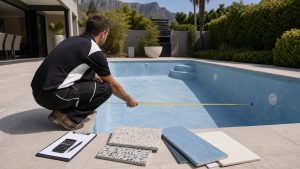
Pool volume in South Africa is measured in litres. For a rectangular pool the calculation is straightforward:
- Rectangular pool: length (m) × width (m) × average depth (m) × 1000 = litres
- Round pool: diameter (m) × diameter (m) × average depth (m) × 785 = litres
- Average depth: add the shallow-end and deep-end depths together and divide by two
As an example, a pool that is 8 m long, 4 m wide and 1.5 m average depth holds roughly 48 000 litres (8 × 4 × 1.5 × 1000).
2. Understand Turnover Rate
Turnover is the time it takes for the pump to circulate a volume of water equal to your entire pool. The widely accepted standard is to turn over the full pool volume roughly every 8 hours during the swimming season. That means the pump should move your whole pool’s worth of water once in an 8-hour running window.
Calculating the Flow Rate You Need
Once you know your volume and your target turnover, the flow rate is simple arithmetic:
- Flow rate = pool volume ÷ turnover hours
Using the 48 000-litre pool from earlier, dividing by an 8-hour turnover gives 6 000 litres per hour. That is the flow rate your pump and filter combination needs to achieve. Pump specifications are usually quoted in litres per hour, so you can compare this figure directly against a manufacturer’s flow chart and pick a model that comfortably meets it.
Don’t Forget the Plumbing
A pump can only push as much water as your pipes will allow. Standard residential pool plumbing in the Western Cape is commonly 50 mm, and each pipe size has a practical maximum flow before friction and noise become a problem. Fitting an oversized pump to undersized pipes creates back-pressure, strains the motor and wastes energy. If you are upgrading, it is worth checking that your suction and return lines, skimmer and filter are all rated to handle the flow you have calculated.
Signs Your Pump Is the Wrong Size
You can often spot a mismatched pump without doing any maths:
- Undersized: water stays cloudy, dead spots collect debris, and the pool struggles to clear even with regular chemicals
- Oversized: high electricity bills, a noisy motor, air being drawn into the system, and filter pressure that climbs too quickly
If any of these sound familiar, resizing the pump usually solves the problem and pays for itself in reduced running costs.
Energy Efficiency and Running Costs
With electricity prices where they are, a correctly sized pump is one of the easiest ways to keep pool running costs down. Rather than running an oversized pump for a short burst, a right-sized pump running steadily over its turnover window uses less power overall. Variable-speed pumps take this further, letting you run at low speed for everyday filtration and higher speed only when vacuuming or backwashing. Over a season the savings add up.
Getting It Right for Your Pool
A pool pump size calculator gives you a solid starting point, but the ideal setup also depends on your pool’s shape, its surface finish and the condition of your plumbing. If you are already planning other work such as fibreglass pool lining or marbelite pool resurfacing in Cape Town, it is the perfect time to review your circulation system as a whole. The team at Aquatic Pools can assess your pool and recommend a pump matched to your exact volume and plumbing. To talk through your options, simply get in touch with our team and we will help you find the right fit.