A retired couple in Somerset West phoned me in April wanting solar pool heating installed before winter. They’d watched a YouTube video. They were convinced they could swim year-round if they just put enough panels on the roof. I drove out, sat with them at the kitchen table, and told them the truth: in Cape Town, no amount of solar panels will get an uncovered pool comfortably swimmable in July. I lost the sale. I also probably saved them R35,000 they’d have regretted spending. This article is the conversation I have with every client who asks about pool heating, with the marketing strip-mined out of it.
The two real options, and a third you should ignore
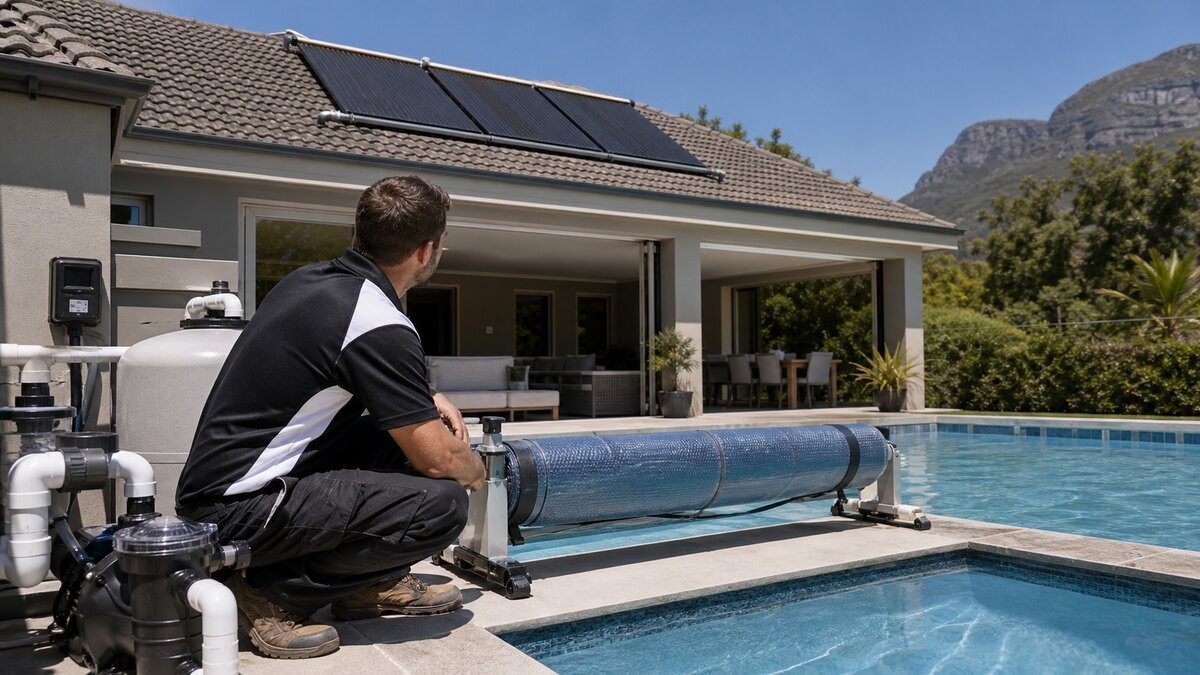
Direct solar panels are the original and still the most common Cape Town pool heater. Flat black collectors mounted on a north-facing roof, fed by a small auxiliary pump (or sometimes by your main pool pump, which I’ll get to). Pool water is cycled through the panels during the day, heated by direct sun, and returned to the pool. No electricity costs beyond running the pump. The cheapest panels are from Solar Ingenuity and ITS Solar at around R1,550 each for a 3 m by 1.2 m collector.
Inverter heat pumps are the modern alternative. An outdoor unit that looks like a fat aircon, uses ambient air as a heat source, and pushes warmth into the pool via a heat exchanger. Heat Pump Pro, Pentair UltraTemp, Hayward, and a handful of locally-imported Chinese brands are what you’ll see installed in Cape Town. Heat pumps draw electricity (efficiently — they output roughly 4 to 6 kW of heat per kW of electricity consumed in our climate) but they’re controllable. You set a target temperature, the unit runs until it hits that, and stops.
The third category — gas heaters — exists, but for residential Cape Town pools it’s almost never the right answer. Expensive per kW, ugly units, fiddly maintenance. Ignore it.
What “warm” actually means
Most clients say they want a “warm” pool without having a number in mind. When I press them, the honest target is 26 to 28°C. Anything below 24°C feels cold to a normal adult; anything above 30°C feels like a bath and grows algae like one.
Cape Town pool temperatures, untreated, look roughly like this through the year:
- December to February: 22 to 26°C, comfortable for most swimmers without intervention.
- October, November, March, April: 17 to 21°C, swim-cold for most adults.
- May to September: 12 to 17°C, properly unpleasant.
The swim season here is functionally October to May. The honest question for any heating system is which shoulder months it can rescue, and the realistic answer for almost any installation is: extends a 6-month season to 9 months, not to 12. Anyone who tells you their system will give you year-round swimming in Cape Town without a fully insulated indoor pool is selling.
Solar panels: what you’ll actually get
The standard rule of thumb in our industry is panel surface area equals pool surface area. For an 8 x 4 m pool, that’s 32 m² of panel — about nine of the standard 3 x 1.2 m collectors. That spec, on a north-facing Cape Town roof with no afternoon shade, will lift your pool temperature roughly 4 to 6°C above the unheated baseline on a sunny day.
Here’s where the south-easter ruins everyone’s calculations. Cape Town’s prevailing summer wind doesn’t just cool the pool surface; it cools the panels too, particularly if they’re mounted on a low-pitch roof exposed to the south side. My honest spec for Camps Bay, Sea Point, Hout Bay, and the wind-tunnel parts of Somerset West is 1.3 times pool surface area. So for that same 8 x 4 m pool, twelve panels instead of nine.
Pricing in 2026:
- Nine-panel solar system, installed: R22,000 to R32,000 depending on roof access, pipe runs, and the choice between tying into the existing pump or installing a dedicated booster pump.
- Twelve-panel wind-exposed spec: R28,000 to R40,000.
- Replacement after 12 to 15 years: roughly the same again. Panels don’t last forever.
Lifespan honestly: 10 to 15 years for the panels themselves. UV degrades the polypropylene over time and the headers eventually start weeping at the seams. The pumps will need replacing once or twice in that lifespan (a decent booster pump runs R3,500 to R6,000 fitted).
Heat pumps: the controllable alternative
A heat pump is what you buy when you want to set 28°C on a dial and have the pool actually get there. Solar panels can only ever give you what the day’s sun delivers. A heat pump runs at night if you want, in overcast weather, and keeps temperature steady within a degree or two of your setpoint.
Current Cape Town pricing for a properly sized residential heat pump (15 to 22 kW output for a standard 50,000 litre pool):
- Heat pump unit: R17,000 to R28,000 depending on brand. Solar Ingenuity, ITS Solar, and a few of the Heat Pump Pro models sit in the R17k to R22k bracket. Pentair and Hayward units run R25k to R35k for the same output class but with better build quality and longer warranties.
- Installation (electrical, plumbing, slab): R4,000 to R8,000.
- Total installed: roughly R21,000 to R36,000.
Running costs are where it gets interesting. A 20 kW heat pump in Cape Town conditions, heating a 50,000 litre pool from ambient (say 18°C in October) to 27°C, will use about 25 to 40 kWh in the initial warm-up. At Eskom’s current residential block tariff of roughly R3.40 per kWh, that’s R85 to R136 for the first heating cycle. Maintaining temperature thereafter (running 4 to 6 hours per day to offset overnight losses) costs around R30 to R60 per day in mid-season.
If you use the pool four days a week from October through April, expect to budget R800 to R1,500 per month on electricity for heat pump operation. Less if you’ve got a thermal cover doing its job. More if you don’t.
The winning combination nobody mentions in adverts
The smartest heated-pool setup in Cape Town isn’t a bigger heater. It’s a smaller heater paired with a proper thermal cover. The cover holds the heat you’ve already paid to put in the water. Without one, your heat pump or solar panels are working against an open evaporative surface that bleeds warmth all night.
The actual numbers: a thermal blanket cuts overnight heat loss by roughly 60 to 70%. That means your heat pump runs for two hours the next morning to recover setpoint instead of five or six. Over a season, that’s the difference between R900 and R1,800 a month in electricity.
The premium version of this argument is a slatted automatic cover. The polycarbonate slats insulate better than any bubble blanket. Combined with a properly sized heat pump, a slatted-cover pool in Constantia can hold 27°C through May without breaking a sweat. The slatted cover costs R85k to R220k installed, which is its own conversation, but if you’re already spending R200k on heating infrastructure the maths can work.
Eskom, load shedding, and the heat pump question
Heat pumps need electricity. That used to be a serious problem in Cape Town between 2019 and 2024 when load shedding was at its worst. We had clients in Plumstead and Durbanville who’d installed beautiful heat pump systems that couldn’t hold temperature because the grid was cycling off for four hours at a stretch.
The situation in 2026 is better but not solved. Stage 1 and 2 load shedding still happens periodically, and Eskom’s tariff has risen roughly 60% over the past four years. If you’re going to run a heat pump in Cape Town, three things matter.
First, get your pool pump and heat pump onto your inverter or solar PV circuit if you have one. The pool pump draws 600 to 1100 watts; the heat pump 3 to 6 kW. The pump can run from a modest hybrid system. The heat pump generally cannot, though you can offset its daytime running with rooftop PV directly.
Second, schedule heating during off-peak periods if you’re on a time-of-use tariff. City of Cape Town’s residential time-of-use plans charge significantly less per kWh between 10pm and 6am. Most modern heat pumps have a timer built in.
Third, factor the tariff trajectory into your payback calculations. If your business case for a heat pump assumes 2024 electricity prices, it’ll be wrong by 2028. I assume 8 to 10% annual tariff increases in my client conversations now.
Solar panels: the system that ignores Eskom entirely
The other side of that coin is the pure solar argument. A direct solar panel system uses no grid electricity beyond the booster pump (and even that can be PV-powered or omitted if your main pool pump is positioned correctly relative to the panels). Your operating cost is functionally zero. Your only ongoing expense is the eventual pump and panel replacement.
The trade-off is control. Solar gives you what the sun gives you. If it’s overcast for three days in November, your pool drops a degree or two. If the south-easter is howling, you lose heat as fast as the panels make it. The system is non-negotiable: it works when conditions are right.
For a household that uses the pool primarily October through April on weekends and during school holidays, solar panels are usually the right answer. For a household that wants the pool warm on demand whenever they decide to swim, a heat pump is the right answer. Try not to mix the two answers in your own head.
Is it worth it? Three honest scenarios
Family with kids who’ll use a heated pool every weekend. Worth it. The kids will swim three times more often with the pool at 27°C than at 21°C. The system pays for itself in family hours in the water over a couple of seasons. Heat pump plus thermal cover is my standard recommendation here. Budget R45k to R55k installed, plus R800 to R1,500 a month in season.
Occasional party host, swims twice a month. Probably not worth it. You’re spending R40k of capital and R5k to R8k a season in running costs to extend a use case that doesn’t need extending. A thermal blanket alone (R3k to R8k) will give you a usable swim season from October to April, and the rest of the year you’re not in the pool anyway. Spend the heating budget on better landscaping or a pizza oven.
Rental property owner (Airbnb, holiday let). Worth it specifically because guests expect a “heated pool” all year, and the listing photos work harder. Solar panels are your friend here because the operating cost is zero and you don’t have to police a tenant’s thermostat. Plan for a thermal cover that’s easy enough for guests to deploy themselves — or skip the cover entirely and accept the heat loss as part of the rental package.
Maintenance and lifespan, frankly
Solar panel systems are mostly maintenance-free for the first decade. The booster pump might need a service at the 5 to 7 year mark (R800 to R1,500 fitted). At 10 to 12 years, panels start to weep and you’ll need to replace the failing ones. At 15 years, most installations want a full system replacement.
Heat pumps are more demanding. The evaporator coil needs cleaning annually (dust and salt air clog the fins, especially in coastal Camps Bay and Hout Bay installs). The titanium heat exchanger is the part that determines lifespan — good for 8 to 12 years if chemistry is held properly. Aggressive chlorine or low pH will pit the titanium and end the unit early. Budget R1,500 annually for service.
Both systems benefit enormously from a well-maintained pool pump. If your main circulation pump is undersized or running on a worn impeller, your heating system is working into a bottleneck. A Pentair Intelliflo or Speck variable-speed pump paired with proper heating is the gold-standard Cape Town setup.
What I’d spec for your pool
If you’ve read this far, you probably already know which category you’re in. The summary version of the spec conversation I have with clients:
- Always start with a thermal cover. No heating system makes sense without one. A R5k thermal blanket adds more usable swim days per rand than anything else you can buy.
- If your budget is under R30k total, go solar panels. Lower running cost, no electricity bill, suits the casual user.
- If your budget is R30k to R60k, heat pump plus thermal blanket. Controllable, fast to setpoint, works for the family-with-kids profile.
- If your budget exceeds R150k, look at a slatted automatic cover and a high-end heat pump together. This is the closest thing to year-round swimming Cape Town allows without going indoor.
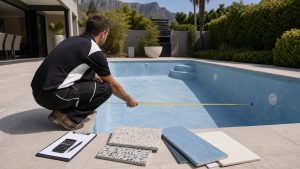
Have a look at our full pool services if you want context on what else we install and maintain, and when you’re ready to talk specifics, phone us on +27 62 635 8990 or request a quote. We’ll come out, measure the pool, check your roof orientation and electrical supply, and recommend the system that fits how you actually use the water — not the most expensive one we can sell you.