Knowing exactly how much water your swimming pool holds is one of the most useful numbers a pool owner in Cape Town can have. Get it right and every dose of chlorine, acid or stabiliser lands where it should. Get it wrong and you either waste chemicals or leave your water unbalanced. A simple pool volume calculator, worked out with a tape measure and a little arithmetic, takes the guesswork out of pool care for good.
Why Pool Volume Matters
Almost every chemical instruction on the back of a bucket is written per volume of water, usually per 10 000 litres. If you do not know your pool’s capacity, you are essentially dosing blind. That is how algae blooms creep in during a Western Cape summer, and how owners end up burning through product far faster than they need to.
- Accurate chlorine and pH dosing that keeps water clear and swimmer-safe.
- Correct stabiliser (cyanuric acid) levels so your chlorine is not cooked off by the sun.
- Sensible salt additions for salt-chlorinated pools.
- Realistic estimates when topping up after backwashing or evaporation.
Because South Africa works in metric, we calculate volume in litres rather than gallons. The core idea is the same everywhere: work out the area of the pool’s surface, then multiply by the average depth.
The Basic Volume Formula
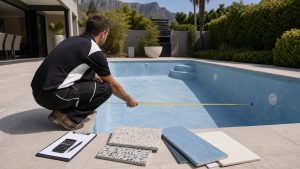
For a metric result in litres, the general rule is:
Length (m) x Width (m) x Average Depth (m) x 1000 = Litres For related pool renovation planning, Aquatic Pools services can help match the repair method to the pool surface and Cape Town conditions.
The multiplier of 1000 simply converts cubic metres into litres, since one cubic metre holds exactly 1000 litres. If you ever see an American formula using length x width x average depth x 7.5, that gives gallons instead, which is not what you want here.
Working Out Average Depth
Many pools slope from a shallow end to a deep end. To find the average depth, add the shallow depth to the deep depth and divide by two. A pool that is 1.0 m at the shallow end and 2.0 m at the deep end has an average depth of 1.5 m.
Calculating Volume By Pool Shape
Rectangular Pools
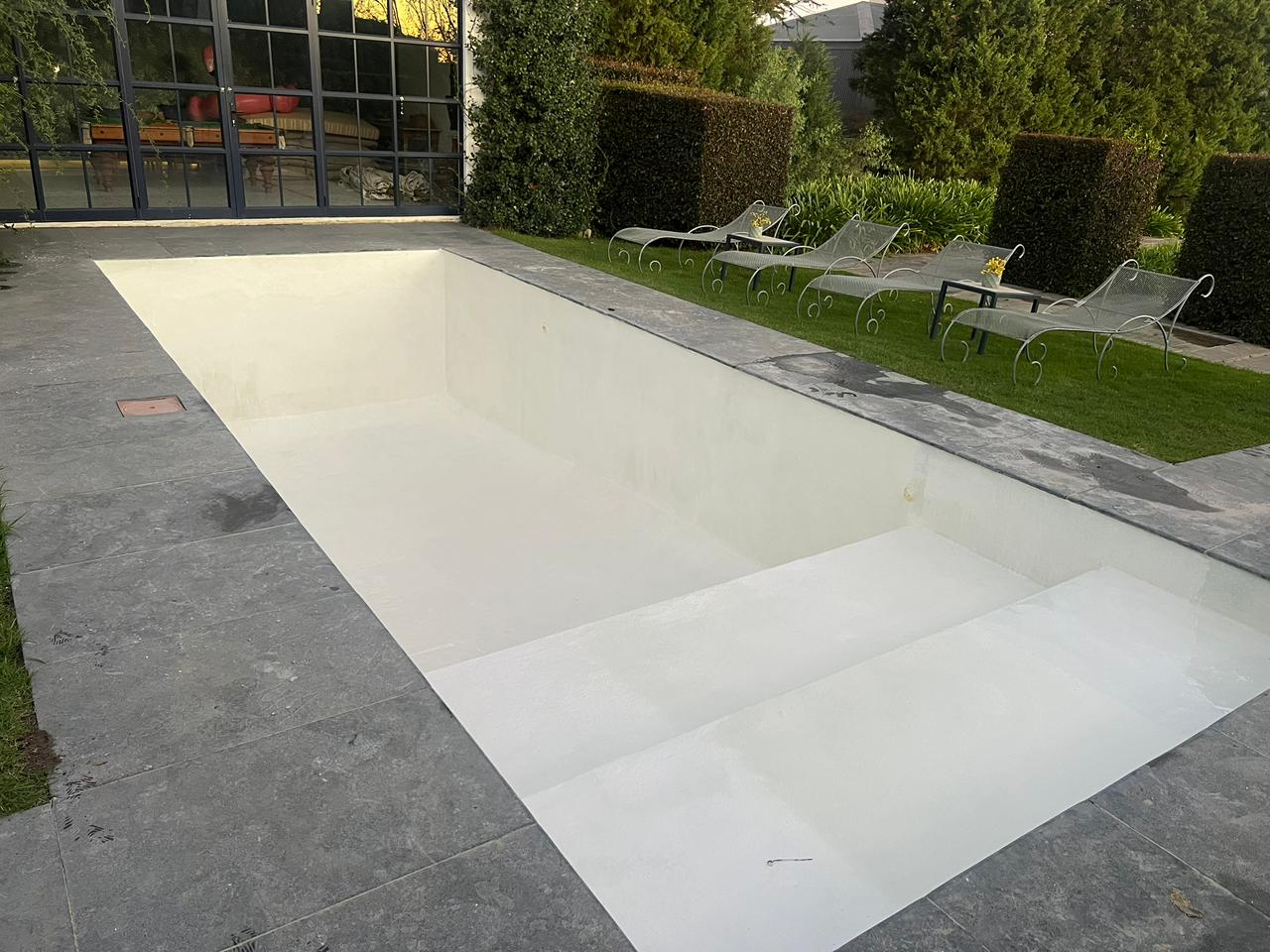
These are the easiest. Measure length, width and average depth, then apply the formula. A pool 8 m long, 4 m wide with an average depth of 1.5 m works out to 8 x 4 x 1.5 x 1000 = 48 000 litres.
Round Pools
For a circular pool, first find the surface area using radius x radius x 3.14, then multiply by average depth and by 1000. So a round pool with a 3 m radius and a 1.4 m average depth is 3 x 3 x 3.14 x 1.4 x 1000, giving roughly 39 500 litres.
Oval Pools
Ovals use half the length times half the width times 3.14 to find the area, then average depth and the 1000 multiplier. It is essentially a stretched circle, so the same principle applies.
Freeform And Kidney Shapes
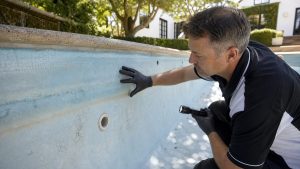
Irregular pools are trickier. A practical approach is to break the pool into rough rectangles and part-circles, calculate each section, and add them together. For very unusual shapes, a professional survey will give you a far more reliable figure than a rough estimate.
Volume, Surfaces And Renovations
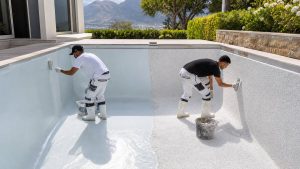
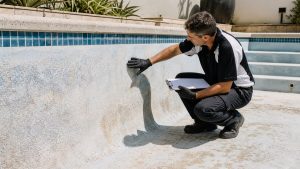
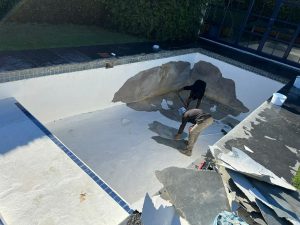
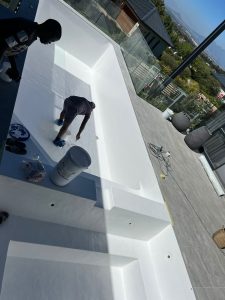
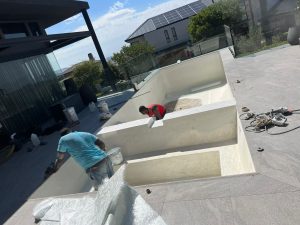
Your pool’s volume is closely tied to its interior surface. When a shell is being relined or resurfaced, the finish can subtly change the water capacity and how the pool behaves. If you are considering a fibreglass pool lining to seal a leaking or rough interior, or opting for marbelite pool resurfacing in Cape Town to restore a tired plaster finish, it is worth recalculating your volume once the work is complete so your dosing stays accurate.
Keeping Your Numbers Accurate
Measure in metres, be honest about your average depth, and write the final litre figure somewhere you will not lose it, such as on the inside of the pump-room door. Recheck it after any resurfacing, reshaping or major repair. With a dependable volume in hand, balancing your water each week becomes a quick, predictable routine rather than a costly guessing game.
If your pool is losing water, showing cracks, or you simply are not confident in your measurements, our specialists can help.
We work with pools of every shape across the Western Cape at Aquatic Pools, and you are welcome to get in touch for advice on capacity, resurfacing and long-term care.