If your chlorine seems to vanish the moment the Cape Town sun hits the water, stabiliser is probably the missing piece. Cyanuric acid — the chemical name for pool stabiliser — acts like sunscreen for your chlorine, slowing how quickly UV burns it off. Get the level right and your chlorine works harder for longer. Get it wrong and you either waste money on chemicals or end up with cloudy, hard-to-treat water. This guide walks you through a simple pool stabiliser calculator approach so you can dose with confidence.
What Does Pool Stabiliser Actually Do?
Unstabilised chlorine in an outdoor pool can lose a large share of its strength within a few hours of direct sunlight. Cyanuric acid bonds loosely with free chlorine, shielding it from UV degradation and releasing it back into the water as it’s consumed. In a sunny climate like the Western Cape, where pools sit in strong light for most of the year, stabiliser isn’t optional — it’s essential for keeping sanitiser levels stable and your maintenance costs sensible.
The Ideal ppm Range
For most residential chlorine pools, you’re aiming for a cyanuric acid level of roughly 30–50 ppm (parts per million). Below about 30 ppm your chlorine burns off too fast; push much above 50 ppm and the stabiliser starts to “lock up” your chlorine, reducing its ability to sanitise. Salt-chlorinated pools often run slightly higher, closer to 60–80 ppm, because the constant low-level chlorine generation benefits from a little extra protection. Always check your chlorinator manufacturer’s guidance.
How to Work Out How Much Stabiliser to Add
The maths behind a pool stabiliser calculator is refreshingly simple once you know two things: your pool’s water volume in litres and your current cyanuric acid reading. As a working rule of thumb, adding around 13 grams of cyanuric acid per 1 000 litres of water raises the level by about 10 ppm.
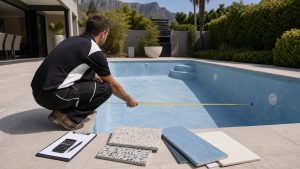
- Step 1 — Find your volume. Length × width × average depth (in metres) × 1 000 gives you litres for a rectangular pool.
- Step 2 — Test your current level. Use a stabiliser test kit or take a sample to your pool shop.
- Step 3 — Find the gap. Subtract your current reading from your target (say, 40 ppm).
- Step 4 — Do the maths. Multiply your volume (in thousands of litres) by 13 grams for every 10 ppm you need to raise.
For example, a 40 000-litre pool sitting at 10 ppm that you want at 40 ppm needs a 30 ppm rise: 40 × 13 × 3 = roughly 1 560 grams of cyanuric acid. Add it via the skimmer or a sock in the pump basket, and run the filtration continuously until it dissolves.
Why You Should Add It Slowly
Stabiliser dissolves slowly and can take a day or two to register fully on a test. Resist the urge to top up again too soon — that’s the most common way people accidentally over-stabilise. Add a measured dose, wait, retest, then adjust.
The Problem With Over-Stabilisation
Once cyanuric acid climbs past about 80–100 ppm, chlorine becomes increasingly “locked” and struggles to keep the water clear, even at normal chlorine readings. This leads to algae blooms and cloudy water that resist treatment. The catch is that stabiliser doesn’t evaporate or break down easily — the only reliable way to lower it is to dilute by partially draining and refilling. In a water-conscious region like Cape Town, that’s a real cost, which is exactly why careful, measured dosing pays off.
Cape Town Context
Our long, bright summers mean local pools lean heavily on stabiliser, but our history with water restrictions means nobody wants to be draining a pool to fix an avoidable over-dose. Keeping cyanuric acid in the sweet spot protects your chlorine, your wallet, and your water. It also protects your fibreglass pool lining and surface finishes — badly balanced, chlorine-starved water can accelerate staining and wear over time. If your marbelite pool surface is already showing rough patches or discolouration, poor chemistry may be part of the story.
When to Call in the Pros
If your readings never seem to settle, or you’re constantly battling cloudy water despite dosing correctly, there may be an underlying issue with your filtration, circulation, or pool surface. The team at Aquatic Pools works with Cape Town pool owners every day to get water balance right and keep pools swim-ready through the seasons. Struggling to get your numbers under control? Get in touch and we’ll help you sort it out properly.
Stabiliser is one of the easiest chemicals to get right and one of the most annoying to get wrong. Test before you dose, add slowly, and aim for that 30–50 ppm range — and your chlorine will thank you all summer long.