Working out how much chlorine to add to your pool is one of the most common questions we hear from Cape Town pool owners. Add too little and algae takes hold; add too much and you waste product and irritate swimmers’ eyes and skin. A simple pool chlorine calculator approach comes down to three things: knowing your pool volume, testing your current free chlorine level, and understanding which type of chlorine you are using. This guide walks you through the maths so you can dose with confidence and keep your swimming pool clean, safe and swim-ready all season.
What Is the Ideal Free Chlorine Level?
Free chlorine is the portion of chlorine actively available to sanitise your water. For most residential pools, the ideal free chlorine range is 1 to 3 parts per million (ppm). Below 1 ppm your water is under-sanitised and vulnerable to algae and bacteria. Above 3 ppm for routine swimming becomes unnecessary and harsh on swimmers.
Chlorine is also affected by your cyanuric acid (CYA), or stabiliser, level. In outdoor pools exposed to strong Cape sun, a CYA level of around 30 to 50 ppm protects chlorine from burning off too quickly. Too much stabiliser, however, locks up your chlorine and makes it far less effective, which is why testing matters just as much as dosing.
Know Your Pool Volume First
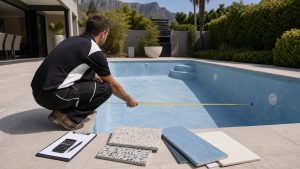
You cannot calculate a dose without knowing how many litres your pool holds. Volume is the foundation of every chlorine calculation. A rough guide for rectangular pools:
- Length × width × average depth × 1000 gives you the volume in litres (measurements in metres).
- A typical 8m × 4m pool at 1.5m average depth holds roughly 48,000 litres.
- For freeform or kidney shapes, estimate an average length and width, then adjust down slightly.
- Keep your calculated volume written down — you will reuse it for every chemical you ever add, from our pool salt calculator to alkalinity dosing.
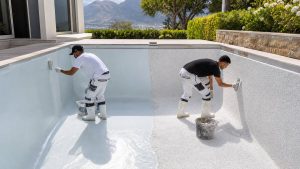
If your pool has recently been resurfaced or relined, the volume may have shifted slightly. Owners who have had fibreglass pool lining installed sometimes find the finished shell holds marginally less water than the old surface.
Understanding the Different Types of Chlorine
Not all chlorine is equal, and each type raises your free chlorine differently:
Liquid Chlorine (Sodium Hypochlorite)
Usually around 12 to 15% available chlorine. It acts fast, adds no stabiliser, and is ideal for quick corrections. Because it is unstabilised, it burns off quickly in sunlight if your CYA is low.
HTH Granular (Calcium Hypochlorite)
Typically 65 to 70% available chlorine. A powerful, cost-effective option for both routine dosing and shocking, though it adds calcium over time.
Stabilised Tablets (Trichlor)
Slow-dissolving tablets around 90% chlorine that also add stabiliser. Excellent for steady, hands-off maintenance through a skimmer or floater, but they steadily raise CYA, so monitor that level.
How to Estimate the Dose
The goal is to raise your free chlorine from its current tested level up to your target. As a practical rule of thumb for a 10,000-litre pool:
- About 85ml of liquid chlorine (12.5%) raises free chlorine by roughly 1 ppm.
- About 15g of HTH granular (68%) raises free chlorine by roughly 1 ppm.
Scale those figures to your own volume. For a 48,000-litre pool needing a 2 ppm boost with liquid chlorine, you would need roughly 85ml × 4.8 × 2, or about 800ml. Always dissolve granular products in a bucket of water first and add along the pool edge with the pump running.
Routine Dosing Versus Shocking
Routine dosing keeps your free chlorine sitting comfortably in the 1 to 3 ppm band day to day. Shocking is a deliberate, much larger dose — raising free chlorine to around 10 ppm or higher — to break down chloramines, clear cloudy water, or kill an algae bloom. Shock in the evening so the sun does not burn it off before it works, and wait until levels drop back to 3 ppm or below before swimming.
Why Testing Is Non-Negotiable
Any calculator only gives you a starting point. Sunlight, rain, swimmer load and temperature all change your chemistry daily, so test at least two or three times a week with a reliable kit or test strips.
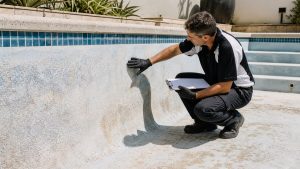
Balanced water also protects your pool’s finish — poorly managed chlorine can stain and etch surfaces. If yours is already showing wear, our marbelite pool resurfacing service can restore it.
If your chlorine never seems to hold, the underlying issue may be high stabiliser, a failing surface, or equipment problems. For the bigger jobs, our pool relining and renovations put it right for good.
Get in touch with our team and we will help you get your water balanced and your pool looking its best.