If your pool water looks clear but your surfaces are scaling up or your equipment is quietly corroding, the culprit is almost always water balance rather than any single chemical reading. The most reliable way to judge that balance is the Langelier Saturation Index (LSI), often called the pool saturation index. It pulls several separate measurements into one number that tells you whether your water is aggressive, balanced, or scale-forming. Understanding it is one of the best ways to protect a newly resurfaced pool for years.
What the Pool Saturation Index Actually Measures
The saturation index describes water’s tendency to either dissolve calcium or deposit it. Water is not a passive container; it constantly seeks equilibrium. When it is short of dissolved minerals it becomes aggressive and pulls calcium out of plaster, marbelite, grout and metal fittings. When it holds too much, it drops that calcium back out as scale on surfaces and inside pipes and heaters. The LSI expresses this balance as a value, and the goal is to sit as close to zero as possible.
As a general guide:
- An index around 0 means the water is balanced and stable.
- A negative index means corrosive, etching water that attacks surfaces and metal.
- A positive index means scale-forming water that leaves rough deposits and cloudy patches.
The Five Factors That Feed the Calculation
The saturation index is calculated from five interrelated readings. No single one tells the full story, which is why simply chasing a “perfect” pH often fails.
- pH – the strongest driver of the index and the fastest to move.
- Total alkalinity – the buffer that keeps pH from swinging wildly.
- Calcium hardness – the amount of dissolved calcium the water is carrying.
- Water temperature – warmer water tends toward scale, cooler water toward corrosion.
- Total dissolved solids – the overall mineral load in the water.
Each reading is converted to a factor and added together, then compared against a constant. You do not need to do the arithmetic by hand – plenty of free saturation index calculators and pool apps will crunch it once you enter your test results, just like our pool volume calculator.
Why Balance Matters for Cape Town Pools
Cape Town’s warm summers, cooler wet winters and variable fill-water quality all push the saturation index around through the year. Water that sat perfectly balanced in December can turn mildly aggressive by mid-winter without a single deliberate change on your part. That slow drift is exactly what damages interiors over time.
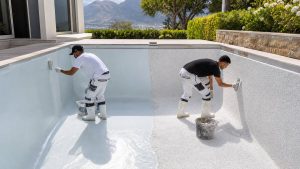
The stakes are highest on the pool’s shell. A well-applied marbelite resurfacing finish can last for many years, but persistently aggressive water etches the surface, roughens it and shortens its life. If you have chosen a fibreglass pool lining instead, balance still matters: while fibreglass resists calcium loss better than plaster, unbalanced water still clouds the finish, stains it and stresses the surrounding fittings and pipework.
How to Use the Index in Practice
You do not need to obsess over the number daily. A practical routine keeps the water inside a safe band:
- Test the five core parameters regularly, and always after heavy rain or a big top-up.
- Adjust one factor at a time – usually pH or alkalinity first – then retest before touching anything else.
- Treat calcium hardness as a slow, seasonal adjustment rather than a weekly fix.
- Recalculate the index after any significant change so you can see the true effect.
Chasing individual readings without checking the overall index is the classic mistake. You can have a textbook pH and still be running corrosive water because the calcium and alkalinity are low. The saturation index is what stops those blind spots.
When to Call in a Professional
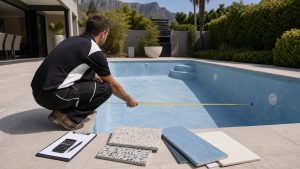
If your index keeps drifting despite careful dosing, or if you can already see etching, scale or staining on the interior, the surface itself may be telling you the water has been out of balance for some time. That is worth a proper assessment rather than another round of chemicals. At Aquatic Pools we look at the whole picture – water chemistry, surface condition and equipment – before recommending anything, because balanced water is what protects any renovation investment.
Whether you are maintaining a healthy pool or planning a full resurface, getting the saturation index right is the quiet foundation everything else rests on. If you would like a hand interpreting your readings or restoring a tired interior, get in touch with our team and we will point you in the right direction.